Sarracenia Winter Pruning in Ireland: Dead Pitchers, Airflow and Grey Mould
Decide what to trim from cultivated Sarracenia this winter, retain useful green foliage, and manage grey mould risk without confusing normal browning with disease.
By Bog & Bite · Published 16 November 2026
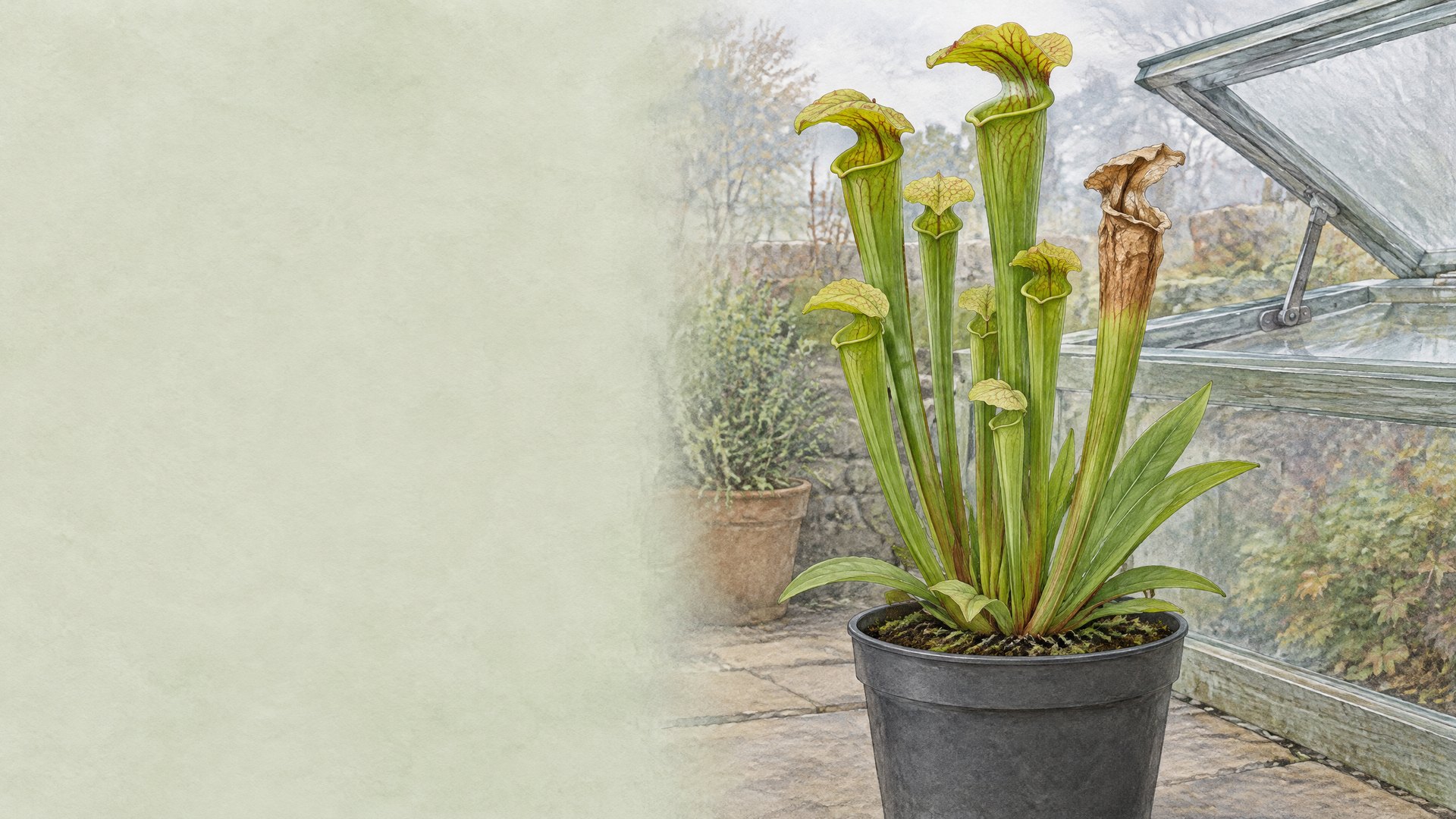
As an Irish container collection settles into winter, the pitchers on a cultivated Sarracenia may look increasingly untidy. Some remain green, others develop dry brown ends, and fallen leaves can gather between the pots. The useful question is not whether every plant should receive a November haircut. It is which tissue is dead, which remains useful, and whether the growing position allows enough air movement.
This guide focuses on winter foliage management in contained Sarracenia collections. It extends the general Sarracenia guide, rather than replacing species-specific winter care. A sheltered outdoor pot and a crowded cold frame do not create the same conditions, so they need not receive identical trimming.
Keep useful green tissue
The International Carnivorous Plant Society explains that Sarracenia recover nutrients from older leaves for use in new growth. Removing green foliage can deprive a plant with a small rhizome of resources. Its usual recommendation is therefore to remove only the brown portions of leaves, except where particular growing conditions justify more thinning. ICPS Sarracenia growing guide
For an otherwise healthy pitcher with a dry brown top and a green lower section, retain the green tissue where practical. A less uniform-looking pot is not a failure of care. Do not strip the plant merely because its neighbour has already lost its old pitchers.
Keep the plant's label with the pot. The ICPS notes considerable variation across species and hybrids, including their seasonal preferences. A single photograph of a neatly cut-back collection is not sufficient evidence that every named plant benefits from the same treatment.
Outdoor pots and covered plants need different judgement
The ICPS distinguishes exposed outdoor plants from those stored in a garage, basement or cold frame. Foliage in protected storage is less exposed to the elements and may harbour pests or reduce air circulation. Tall-pitchered plants in such settings can benefit from thinning in autumn, particularly when old leaves create a dense barrier.
For plants outside without cover, the same source generally favours leaving green foliage and removing dead leaves or brown ends. It notes an exception where a dense thatch has formed, as can happen in the Sarracenia rubra group. This is a condition-based decision, not a requirement to cut every pot to the same height.
In your own Irish setup, look at the foliage and the space around it. Are old tubes packed tightly together in a sheltered enclosure? Are neighbouring pots pressing against one another? Could spacing them improve airflow without removing living leaves? Address the actual obstruction rather than treating shelter itself as a problem.
The Sarracenia plant hub provides the wider cultivation context. If you are considering an enclosure, the carnivorous-plant terrarium guide explains why containment and ventilation must be considered together.
Respect the low-growing pitcher species
The ICPS specifically says that S. purpurea, S. rosea and S. psittacina should have their pitchers removed only when they turn brown. Do not apply a tall-trumpet pruning routine to a green, low-growing rosette just because both belong to Sarracenia.
This distinction matters when several plants share a container. Work around each named plant rather than sweeping through the display with one cut. If a pitcher is still green and not obstructing anything, there may be no reason to remove it during a routine tidy-up.
The hero above is an original botanical illustration of mixed green and fading foliage. It is not a local trial photograph or a diagnostic reference for fungal disease.
Normal browning is not a grey mould diagnosis
A dry, brown pitcher is not automatically infected. The Royal Horticultural Society describes grey mould, caused by Botrytis cinerea, as soft decay accompanied by fuzzy grey-brown growth. It can affect many plants, and humid, overcrowded conditions under glass are particularly relevant. RHS grey mould guide
The RHS carnivorous-plant guide also identifies grey mould as a possible fungal problem, especially in indoor cultivation. That supports taking hygiene and airflow seriously, but not labelling every fading pitcher as diseased. RHS carnivorous-plant growing guide
If tissue is soft, collapsing or visibly mouldy, inspect it separately from dry seasonal dieback. These observations do not establish the cause of every crown or rhizome problem. If decline reaches the growing point or continues after basic conditions are corrected, seek species-specific advice rather than repeatedly cutting healthy tissue or applying an unverified treatment.
Remove suspect material carefully
For grey mould, the RHS recommends removing affected and dead material and avoiding accumulations of debris in protected growing spaces. It warns that spores disperse easily when affected parts are handled. Where possible, enclose visibly affected material in a bag before or immediately after removing it.
Take time to see the leaf base and the living growing point. Use clean cutting tools and remove clearly dead portions without tugging at the rhizome. Avoid forcing a blade through a bundle of leaves simply because their bases are difficult to reach. A tidy-up should not create unnecessary wounds.
Do not leave suspect clippings among the pots. The RHS takes a more relaxed approach to healthy dead material in outdoor garden settings because it can provide wildlife habitat; that is different from leaving visibly affected debris in a crowded cold frame. You do not need to clear an entire garden to manage a contained collection.
Improve airflow without drying the roots
The RHS recommends better ventilation and less overcrowding to reduce humidity around plants affected by grey mould. In a cold frame or greenhouse, consider the spacing between containers and whether vents can be opened safely during suitable weather. Ventilation should be balanced with the named plant's protection needs, not left unchanged regardless of the forecast.
Do not translate this into a demand for dry growing medium. The ICPS warns that Sarracenia should not dry out. Foliage humidity and root-zone moisture are related parts of the setup, but they are not interchangeable. Keep the medium moist while checking that drainage or overflow arrangements still work as intended.
After wind or heavy rain, inspect the outer container for displaced pots, blocked outlets and trapped debris. Under cover, check moisture rather than assuming that nearby rainfall has watered the plant. Neither a fixed watering interval nor a universal tray depth suits every container.
If your water supply needs review, use the guide to water for carnivorous plants in Ireland. Do not add fertiliser to make a resting plant grow through winter; the RHS notes that most carnivorous plants need no additional fertiliser.
Revisit obstructive foliage as spring growth begins
The ICPS notes that old pitcher tops can snag flower stems and new leaves as growth resumes. Look for those obstructions when the plant starts to grow rather than committing to a fixed date for a complete cut-back. Remove the interfering dead portions carefully and continue to retain useful green tissue.
Pruning and division are separate jobs. An untidy plant does not automatically need its rhizome split or its medium replaced. If the pot is genuinely crowded and you are planning a spring division, see Dividing Sarracenia in Ireland before disturbing it.
Record what you removed, whether the plant was outdoors or under cover, and any signs of soft decay. Those notes help you compare the same plant next winter without turning one season's experience into a guarantee. Good hygiene and airflow can address important risk factors, but they cannot promise that disease will never occur.
A short winter foliage check
- Identify the species or hybrid before deciding how much to trim.
- Retain healthy green tissue and remove clearly dead portions selectively.
- Assess crowding and airflow, especially in protected winter storage.
- Treat soft or visibly mouldy tissue separately from ordinary dry browning.
- Remove suspect debris carefully rather than leaving it between pots.
- Keep the medium moist while maintaining ventilation and container drainage.
- Recheck obstructive old foliage when spring growth becomes visible.
Research & sources
These references support the practical and conservation notes on this page.
- International Carnivorous Plant Society — Growing Sarracenia: Species-specific trimming, nutrient recovery from older foliage, outdoor versus protected winter cultivation, retaining green pitchers and avoiding root-zone drying.
- Royal Horticultural Society — Grey mould: Symptoms and nonchemical cultural management of Botrytis, including careful removal of affected material, hygiene, ventilation and avoiding overcrowding.
- Royal Horticultural Society — How to grow carnivorous plants: General pruning and low-nutrient care, and identification of grey mould as a possible problem in carnivorous-plant cultivation; ICPS supplies the more specific Sarracenia trimming guidance.
Frequently Asked Questions
Should I cut all my Sarracenia pitchers down in November?
Not by default. The ICPS generally recommends removing only brown leaf portions, and distinguishes plants exposed outdoors from tall-pitchered plants in protected winter storage where dense foliage can restrict airflow. Species, foliage condition and growing position matter more than a fixed date.
What if only the top of a pitcher is brown?
For an otherwise healthy plant, remove the dead brown portion while retaining green tissue where practical. Do not remove the whole pitcher simply to make the pot look uniform. If tissue is soft, collapsing or visibly mouldy, assess that problem separately from ordinary seasonal dieback.
Should Sarracenia purpurea be treated like an upright trumpet pitcher plant?
The ICPS gives specific advice for Sarracenia purpurea, S. rosea and S. psittacina: remove their pitchers only when they turn brown. Green pitchers should not be discarded just because other plants in the collection have been cut back.
Does a brown pitcher mean grey mould?
No. Browning alone does not establish a disease diagnosis. The RHS describes grey mould as soft decay accompanied by fuzzy grey-brown growth under humid conditions. Review the tissue and growing conditions rather than assuming that every old pitcher has Botrytis.
Should I dry out the pot to prevent fungus?
No. The ICPS warns that Sarracenia should not dry out. Manage dead material, spacing and ventilation while keeping the growing medium moist and monitoring container drainage. A humidity problem around the foliage is not a reason to desiccate the roots.