Carnivorous Plant Terrariums: Good Idea or Bad Idea?
Glass fishbowls and enclosed demijohns look gorgeous on Instagram, but often prove fatal for temperate carnivores. Here is which species suit terrariums and which do not.
By Bog & Bite · Published 25 September 2026
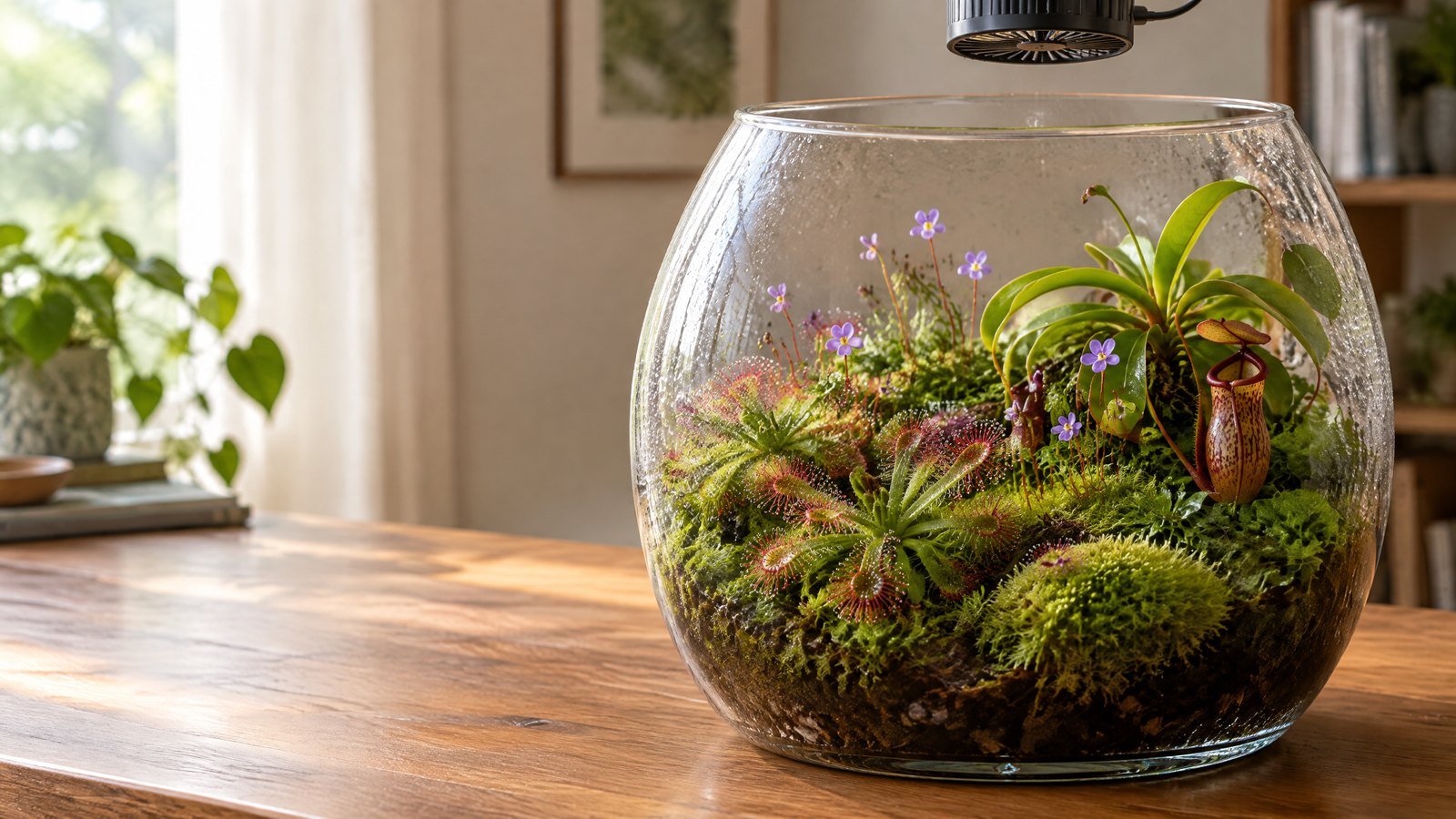
Type #terrarium into Instagram or Pinterest and you will inevitably be greeted by enchanting photographs of miniature mossy landscapes trapped inside glass globes, bell jars, and Victorian Wardian cases, with Venus flytraps snapping their jaws beneath droplets of glass condensation.
It looks like the quintessential botanical fairy tale. And it is responsible for the demise of countless thousands of carnivorous plants every year.
The blunt horticultural reality is that closed glass terrariums are death traps for the vast majority of popular temperate carnivorous plants. Yet, when designed correctly with appropriate species, a modern open-top or climate-controlled terrarium can be an extraordinary display case for tropical and cloud-forest insectivores.
Here is how to navigate the fine line between horticultural disaster and botanical masterpiece.
Why Terrariums Kill Temperate Carnivores (Dionaea & Sarracenia)
If you plant a Venus flytrap or a North American pitcher plant (Sarracenia) inside a classic closed glass container, you are creating a biological torture chamber:
- The Greenhouse Solar Cooker Effect: Terrarium plants need intense light. But if you place a closed glass vessel in direct sunlight on an Irish south-facing windowsill, the glass traps infrared radiation. Within two hours, internal temperatures can exceed 45°C to 50°C—literally parboiling the plant tissue.
- Zero Airflow and Fungal Explosion: In the wild, coastal Carolina bogs are exposed to constant Atlantic sea breezes. Inside stagnant, saturated glass air, fungal spores (Botrytis cinerea) germinate within hours, turning the plant into a grey, rotting mess.
- The Drainage Trap: Terrariums do not have bottom drainage holes. As water accumulates, the lower substrate turns completely anaerobic, smelling of sulfur and rotting the root system.
- No Winter Dormancy: In winter, when these plants must experience 3 to 4 months of 2°C–8°C cold, the terrarium remains in a heated 20°C room, exhausting the plant.
Which Carnivorous Plants Actually Belong in a Terrarium?
While temperate bog species loathe terrariums, there is an entire world of tropical, sub-tropical, and cloud-forest carnivores that demand the high, stable humidity and controlled temperatures that a modern glass enclosure provides:
1. The Queensland Rainforest Sundews (The "Three Sisters")
- Species: Drosera adelae, Drosera prolifera, Drosera schizandra.
- Native Habitat: Shaded, dripping mossy creek banks in the tropical rainforests of northeastern Australia.
- Why they love terrariums: They require constant 75% to 90% humidity, moderate temperatures (18°C–24°C), and low to medium diffused light. Exposed to dry Irish domestic air, their dewy leaves crisp and wither immediately; inside glass, they grow like weeds.
2. Terrestrial Bladderworts (Utricularia)
- Species: Utricularia sandersonii (the famous "angry bunny" orchid-like flowers), Utricularia livida, Utricularia bisquamata.
- Why they love terrariums: They form miniature emerald carpets of tiny moss-like leaves, sending up hundreds of delicate fairy blossoms. Their underground subterranean bladders catch microscopic nematodes in the damp peat.
3. Miniature Mexican Butterworts (Pinguicula)
- Compact species like P. esseriana and P. ehlersiae can be grown in open-top rock-scape terrariums on porous volcanic pumice stones.
The Anatomy of a Successful Carnivorous Terrarium
If you want to build a functional, healthy carnivorous terrarium in Ireland, avoid decorative candy jars and follow these engineering principles:
- The False Bottom (Drainage Layer):
- Never let peat sit directly on the solid glass floor.
- Create a 3 cm false bottom using expanded clay pebbles (Leca) or light diffuser plastic ('egg-crate') separated from the soil by a layer of porous fiberglass mesh.
- Insert a narrow vertical siphon tube so you can pump out excess accumulated water with a turkey baster or syringe.
- Artificial LED Lighting Only:
- Never expose a glass terrarium to direct sunlight. Use cool-running, full-spectrum LED panels mounted 20 cm to 30 cm above the glass.
- Active Air Circulation (Micro-Fans):
- Stagnant air breeds rot. Install a tiny 5V USB computer fan inside the top lid, wired to run for 10 minutes every two hours. Gentle airflow strengthens plant cell walls and prevents fungal outbreaks.
- Open-Top Ventilation:
- Leave at least 20% of the top open to allow gas exchange, or use a fine stainless steel mesh cover rather than a sealed glass lid.
Design for ventilation and the mature plant
A terrarium can be a useful tool for a small plant that benefits from a more stable humid environment, but it is not a universal solution for carnivorous plants. Closed glass can trap heat, reduce air movement and quickly become impractical for a climbing Nepenthes. Many common hybrids are better suited to a bright windowsill, grow shelf or hanging position with good drainage and modest room humidity.
Before choosing an enclosure, identify the plant and decide how it will be ventilated, watered, lit and eventually accommodated as it grows. Use a thermometer in the growing area rather than guessing the temperature from the room. If supplemental heat is used, a thermostat is essential. A terrarium should solve a defined environmental gap, not hide several unresolved problems at once. Clemson Extension Nepenthes guide NECPS Nepenthes guide
Continue learning
- Growing Nepenthes in an Irish Home — Choose a space that accommodates a climbing tropical pitcher plant.
- Heat Mats for Carnivorous Plants — Use a thermostat and measure enclosure air temperature.
- Grow Lights for Carnivorous Plants — Provide safe, appropriate light without overheating a closed setup.
Research & sources
These references support the practical and conservation notes on this page.
- Clemson Cooperative Extension — Tropical Pitcher Plants (Nepenthes spp.): Indoor Care: Species and hybrid variation, light, humidity and indoor growing methods.
- New England Carnivorous Plant Society — Basic Nepenthes Cultivation: Lowland, highland and hybrid cultivation distinctions.
- Carnivero — Nepenthes Care Guide: Hybrid tolerance, drainage, light and lack of winter dormancy.
- Tom’s Carnivores — Tropical Pitcher Plants: How to Care for Nepenthes: Species-led rather than one-size-fits-all indoor care.
Frequently Asked Questions
Can I put a Venus flytrap in a closed glass jar terrarium?
No, it is almost guaranteed to die. Enclosed glass creates high humidity, stagnant air, zero drainage, and extreme heat spikes under sunlight that cook the rhizome. Furthermore, flytraps cannot undergo proper cold winter dormancy inside a warm living room terrarium.
Which carnivorous plants actually thrive inside an indoor terrarium?
Tropical terrestrial species that appreciate high humidity (65–85%) and stable warm temperatures: Drosera prolifera, Drosera adelae, terrestrial Utricularia (bladderworts), Cephalotus follicularis (with high airflow), and juvenile highland Nepenthes.
How do you prevent mould and algae in a carnivorous terrarium?
Incorporate small 5V computer fans to maintain continuous gentle air circulation, install a false bottom with egg-crate plastic and leca balls so water does not stagnate in the peat, and use only pure distilled or reverse osmosis water.