Best Grow Lights for Carnivorous Plants in Ireland
Irish winter daylight drops to 7.5 hours of weak overcast sky. Here is how to choose modern full-spectrum LED grow lights, calculate PPFD, set photoperiods, and keep plants thriving.
By Bog & Bite · Published 25 September 2026
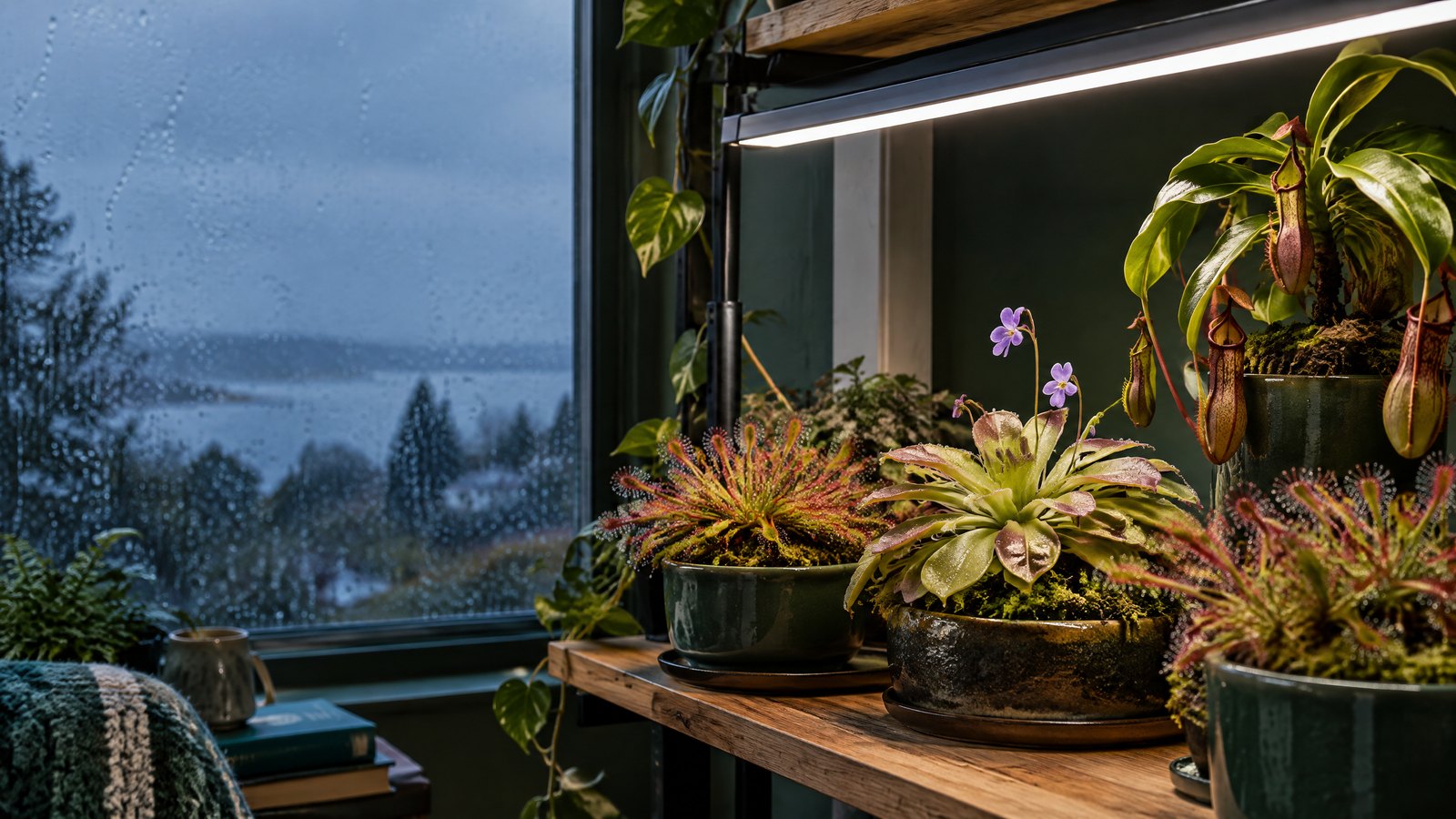
Between late October and early March, Ireland undergoes a dramatic astronomical contraction. At the winter solstice on 21 December, Dublin experiences just 7 hours and 30 minutes between sunrise and sunset; in Donegal and the north-west, it is even shorter.
Compounding the short day length is our persistent maritime cloud cover. An overcast December day in Ireland delivers ambient indoor windowsill light levels of fewer than 500 to 1,500 lux—a mere fraction of the 30,000 to 80,000 lux that carnivorous plants evolved to expect in open, sun-baked wetlands.
If you are growing non-dormant carnivorous plants indoors—such as South African sundews, tropical Nepenthes, or Mexican Pinguicula—supplemental LED lighting is not a luxury gadget; it is the fundamental bridge that keeps your plants alive and photosynthetic until spring.
Understanding Light Metrics: Lux vs PPFD
Forget watts as a measurement of brightness. A 50W halogen bulb produces mostly heat and very little usable light. In modern horticulture, two metrics matter:
- Colour Temperature (Kelvin): Look for 4000K to 6500K. This mimics bright, crisp natural daylight. It renders the deep greens, sparkling dew droplets, and crimson traps beautifully in your living room, unlike dated purple-magenta LEDs.
- PPFD (Photosynthetic Photon Flux Density): Measured in µmol/m²/s, this measures the actual photons within the photosynthetically active radiation (PAR) band (400–700 nm) striking a square metre of leaf surface per second.
PPFD Targets for Carnivorous Plants:
- *Mexican Pinguicula (Butterworts):* 80 – 150 µmol/m²/s (Moderate light)
- **Nepenthes (Tropical Pitchers):** 100 – 220 µmol/m²/s (Bright, diffused light)
- **Drosera (Sundews, e.g., D. capensis):** 180 – 350 µmol/m²/s (High light; essential for dew production)
- **Dionaea & Sarracenia (Summer indoor culture):** 350 – 550+ µmol/m²/s (Intense sun; very difficult to achieve without commercial-grade boards)
Recommended Grow Light Form Factors for Irish Homes
1. Spotlight Bulbs (E27 Screw Fitting)
- Best for: Single plants or a small cluster of 2–3 pots on a desk, bookshelf, or side table.
- Top Options: Sansi 24W or 36W Full Spectrum Daylight LED bulbs.
- Why they work: They screw into any standard architectural desk lamp, goose-neck clamp, or pendant light fixture with an E27 ceramic socket. They run quietly, run warm rather than scorchingly hot, and throw a focused 60-degree beam directly over your plants.
2. Linear LED Batten / Bar Lights
- Best for: Windowsills, multi-tier plant shelving units, or IKEA cabinet conversions.
- Top Options: Barrina T5 or T8 integrated LED bars, Spider Farmer, or Arcadia Jungle Dawn LED bars.
- Why they work: Extremely slim profile; can be secured with double-sided mounting tape or cable ties beneath wooden or glass shelves. They provide uniform, shadow-free illumination across a 60 cm to 120 cm row of pots.
3. Quantum Board LED Panels
- Best for: Dedicated indoor grow spaces, open shelving holding 15+ plants, or light-hungry sundew collections.
- Top Options: VIPARSPECTRA XS1000 / P1000, Spider Farmer SF1000, or Mars Hydro TS600.
- Why they work: Built with high-efficiency Samsung LM301B diodes, these boards deliver immense photon density across a 60 × 60 cm canopy while consuming only 100W. They feature built-in dimmers, allowing you to dial down intensity for young seedlings and crank it up for maximum colouration.
Setting Photoperiods and Timers
Carnivorous plants rely on the duration of light (photoperiod) as an internal biological clock.
- Never switch lights manually: You will inevitably forget on busy days. Spend €5 on a mechanical plug-in timer or €10 on a Wi-Fi smart plug (like TP-Link Tapo).
- Summer Schedule (April – September): 14 to 16 hours of daily illumination.
- Winter Schedule for Tropicals (October – March): 12 to 14 hours daily to maintain steady active growth without triggering stunted dormancy leaves.
- Distance Matters: Keep LED bar lights 15 cm to 25 cm above sundews and butterworts. For high-powered 100W quantum boards, maintain 30 cm to 45 cm distance to prevent heat stress and bleaching.
Reading the Plant: Signs of Light Health
- Sufficient Light: Deep red or crimson anthocyanin coloration inside flytrap lobes; dense, glistening droplets of sticky mucilage on sundew tentacles; compact, short-stemmed rosettes on butterworts; robust pitcher formation on Nepenthes.
- Insufficient Light: Foliage stretches upward toward the light source (etiolation); leaf blades become abnormally wide and floppy; sundew tentacles lack glistening dew droplets; new leaves are pale yellow-green.
- Light Stress (Too Close): Leaves develop white bleached blotches or crispy brown margins; tips curl downward defensively. Raise the light source by 5–10 cm immediately.
Set a baseline, then watch the plant
Choose a fixture that is safely installed, suits the footprint of the growing area and can be run on a timer. Start at a conservative distance and schedule, follow the manufacturer’s guidance, and change only one variable at a time. A plant’s response matters more than a single advertised wattage: pale stretched growth can suggest insufficient light, while bleaching, crispy patches or rising leaf temperature may mean the light is too intense or too close.
Different groups respond differently. Many bog plants appreciate very bright light, while Nepenthes often prefer bright, mostly diffused light. Supplemental light can be particularly helpful for evergreen tropical plants through darker months, but it should not be used to override a temperate plant’s need for a cooler rest. The RHS cautions that direct sun through glass can scorch tender tropical plants; use the species or hybrid as the starting point. RHS carnivorous-plant guide
Continue learning
- Growing Nepenthes in an Irish Home — Use bright but mostly diffused light for tropical pitchers.
- Carnivorous Plants Indoors During an Irish Winter — Plan a realistic winter indoor routine.
- Sundews in Ireland — Read how species choice changes light and seasonal care.
Research & sources
These references support the practical and conservation notes on this page.
- Clemson Cooperative Extension — Tropical Pitcher Plants (Nepenthes spp.): Indoor Care: Species and hybrid variation, light, humidity and indoor growing methods.
- New England Carnivorous Plant Society — Basic Nepenthes Cultivation: Lowland, highland and hybrid cultivation distinctions.
- Carnivero — Nepenthes Care Guide: Hybrid tolerance, drainage, light and lack of winter dormancy.
- Tom’s Carnivores — Tropical Pitcher Plants: How to Care for Nepenthes: Species-led rather than one-size-fits-all indoor care.
Frequently Asked Questions
What kind of light spectrum do carnivorous plants need?
Modern full-spectrum white LEDs (4000K to 6500K daylight white) with high CRI are optimal. The old 'blurple' (pink/purple) LED panels are visually unpleasant in living spaces and offer no physiological advantage over balanced white diodes.
How many hours per day should grow lights run in an Irish winter?
For actively growing indoor tropical and subtropical species (like Drosera capensis or Nepenthes), run grow lights on a mechanical or digital timer for 12 to 14 hours per day. For dormant temperate plants, do NOT provide long artificial photoperiods.
How much electricity does a 30W LED grow light cost to run in Ireland?
At an average Irish domestic electricity rate of €0.35 per kWh, a 30W LED panel running for 14 hours daily consumes approximately 0.42 kWh per day—costing roughly 15 cents per day, or less than €4.50 per month.