Growing Nepenthes in an Irish Home: Windowsill Realities
Tropical pitcher plants are captivating, but our cold, dark winters and dry radiators present unique challenges. Here is how to keep Nepenthes thriving indoors.
By Bog & Bite · Published 25 September 2026
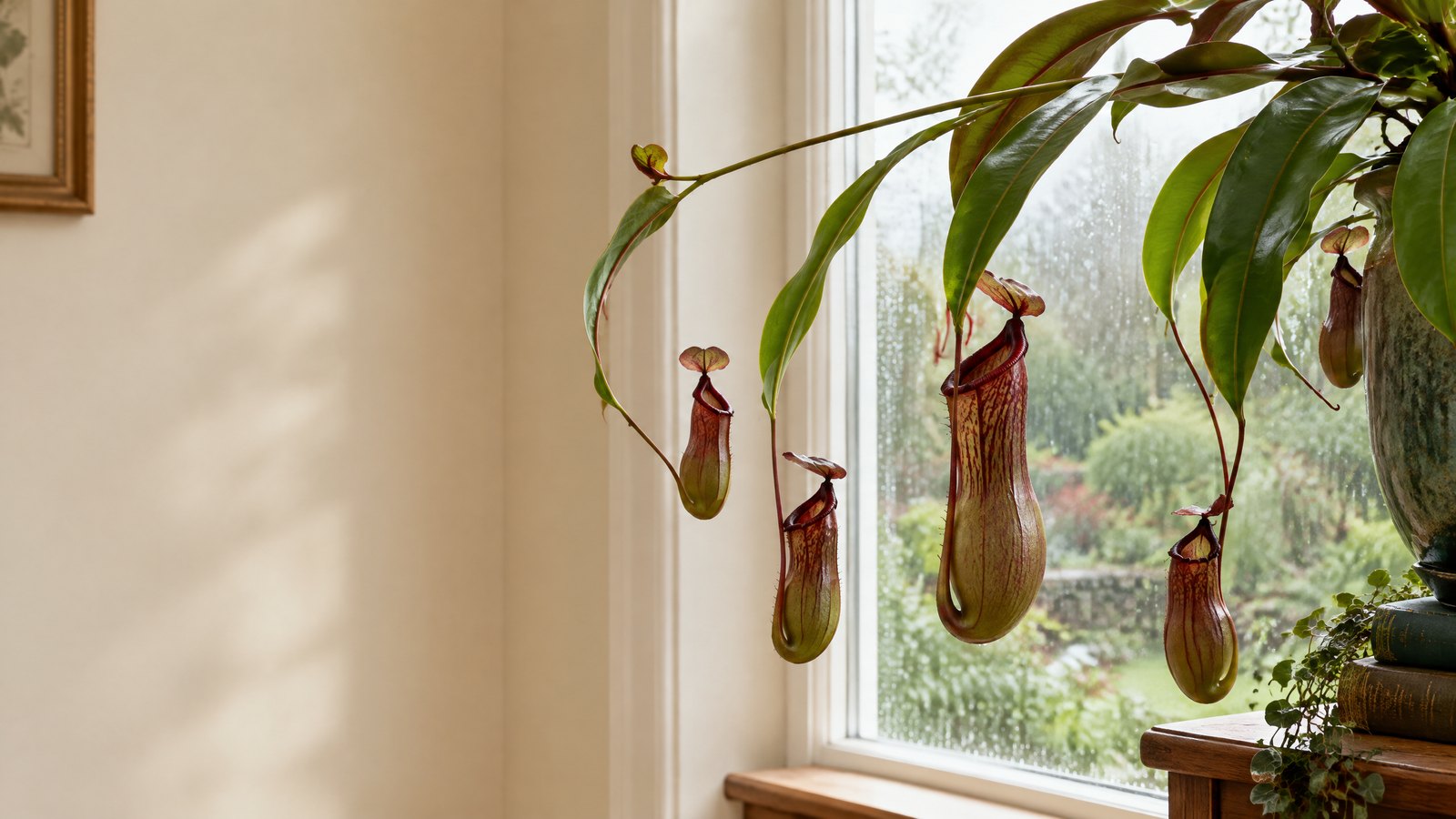
With their exotic pendulous pitchers, glossy tropical foliage, and predatory elegance, Nepenthes (tropical pitcher plants) are frequently the plant that draws curious gardeners into the world of botanical carnivory. Originating across the humid tropical rainforests of Southeast Asia—primarily Borneo, Sumatra, the Philippines, and Madagascar—they look like creatures straight out of an equatorial paradise.
Yet walking out of an Irish garden centre with a hanging basket of Nepenthes in October often marks the start of a familiar heartbreak: within eight weeks of bringing the plant home, the existing pitchers shrivel and turn brown, and the new leaves produce bare, thin tendrils that stubbornly refuse to inflate into new pitchers.
Growing Nepenthes in Ireland is entirely achievable, but only if you reject generic carnivorous plant advice (such as standing them in water) and adapt your care to the thermal and luminous realities of an Irish domestic interior.
The Fundamental Divide: Highland vs Lowland Species
Before purchasing a Nepenthes, you must know whether it is a highland or lowland species. Attempting to grow the wrong type in an Irish home without climate control will lead to failure.
1. Highland Nepenthes (The Natural Fit for Irish Homes)
- Native Habitat: High-altitude tropical mountain cloud forests (1,000 m to 2,500 m above sea level) in Borneo and Sumatra.
- Temperature Profile: Warm, bright days (21°C–26°C) followed by a mandatory, sharp drop at night to 10°C–15°C.
- Why they suit Ireland: Modern Irish homes naturally mimic this temperature swing! In autumn and winter, our heating runs during the day and shuts off at night, allowing indoor temperatures to drop into the teens.
- Top Species/Hybrids: N. alata, N. ventricosa, N. burkei, N. sanguinea, and hybrids like N. × ventrata.
2. Lowland Nepenthes (Demanding Specialist Plants)
- Native Habitat: Lowland coastal rainforests and swamp forests (0 m to 500 m above sea level).
- Temperature Profile: Constant tropical heat (28°C–34°C day, 22°C–25°C night) and relentless 80% to 95% relative humidity year-round.
- Why they struggle in Ireland: If a lowland plant drops below 16°C in a chilly Irish room in January, its growth stalls and the leaves turn yellow. They cannot be grown on open windowsills in Ireland; they demand a heated indoor grow tent or converted glass terrarium with heat mats and humidifiers.
The Two Golden Rules of Nepenthes Cultivation
Rule 1: Never Stand a Nepenthes in Water
Unlike Dionaea, Drosera, and Sarracenia, which are marsh and bog dwellers, many Nepenthes grow as epiphytes on trees or in well-drained mossy embankments. Their fine root systems require copious amounts of oxygen.
- The Watering Method: Water thoroughly from above using pure rainwater or reverse osmosis water until it flows freely from the drainage holes. Empty the saucer or outer decorative cachepot completely. Allow the top centimetre of media to dry slightly between waterings.
- The Substrate: Never use heavy peat. Use an open, airy mix such as:
- 50% Long-Fibre Sphagnum Moss (dried or live)
- 30% Coarse Horticultural Perlite
- 20% Orchid Bark or Pumice
Rule 2: Light Triggers Pitchering, Humidity Simply Preserves Them
The most common myth repeated by beginners is: "My plant isn't making pitchers because the room isn't humid enough."
While low humidity can desiccate developing tendril tips, insufficient light is often an important reason for poor pitcher formation, alongside acclimatisation, temperature, watering, root health and plant identity. Improve one condition at a time and judge the response from new growth rather than assuming humidity is the only issue. Light provides the energy required to construct pitchers.
Winter Care in an Irish Home
Between November and February, Irish homes present two severe threats:
- Central Heating Desiccation: Radiators drop indoor relative humidity from a pleasant 65% down to 35% or lower. Place your Nepenthes in a bathroom with an east- or south-facing window, group several houseplants together on pebble trays filled with water (keeping pot bases above the waterline), or run a small ultrasonic room humidifier.
- Daylight Deficit: With daylight shrinking to 7.5 hours of weak twilight, install a Sansi 24W or 36W full-spectrum LED bulb in a flexible desk lamp 30 cm above the plant, set on a timer for 12 hours daily.
If you provide a bright windowsill, an airy sphagnum substrate, and supplemental winter lighting, vigorous hybrids like Nepenthes × ventrata will reward you with dozens of glossy, carnivorous pitchers dangling gracefully right through the year.
Identify the plant before changing its environment
Lowland, highland and intermediate labels are useful starting points, but they do not replace knowing the species or hybrid on the label. Temperature needs are influenced by parentage, and many commonly sold hybrids are more adaptable than a pure species from a specialised habitat. Avoid responding to poor pitcher production by automatically sealing the plant into a humid terrarium or adding heat.
Instead, check the basics in order: bright mostly diffused light, a freely draining medium, low-mineral water, warm frost-free conditions and a recent change in the plant’s environment. Higher humidity can help some plants, but a tolerant hybrid may acclimatise to ordinary household humidity if light, water and temperature are otherwise sound. Nepenthes do not need a winter dormancy; darker days may slow growth, which is different from a temperate plant’s cold rest. Clemson Extension guide Tom’s Carnivores guide
Continue learning
- Carnivorous Plant Terrariums — Decide whether a controlled enclosure suits the plant’s size and needs.
- Heat Mats for Carnivorous Plants — Use supplemental warmth only for a measured need.
- Grow Lights for Carnivorous Plants — Improve winter light before treating humidity as the only cause of poor pitcher production.
Research & sources
These references support the practical and conservation notes on this page.
- Clemson Cooperative Extension — Tropical Pitcher Plants (Nepenthes spp.): Indoor Care: Species and hybrid variation, light, humidity and indoor growing methods.
- New England Carnivorous Plant Society — Basic Nepenthes Cultivation: Lowland, highland and hybrid cultivation distinctions.
- Carnivero — Nepenthes Care Guide: Hybrid tolerance, drainage, light and lack of winter dormancy.
- Tom’s Carnivores — Tropical Pitcher Plants: How to Care for Nepenthes: Species-led rather than one-size-fits-all indoor care.
Frequently Asked Questions
Why has my Nepenthes stopped producing pitchers in winter?
The primary cause of pitcher failure in an Irish home is light starvation combined with low indoor humidity caused by central heating. Without sufficient light intensity (12+ hours of bright light) and at least 50% relative humidity, the tendrils abort before swelling into pitchers.
Can I grow a Nepenthes on an ordinary Irish windowsill without a terrarium?
Yes! Resilient hybrid cultivars—specifically Nepenthes × ventrata, N. 'Gaya', and N. 'Bloody Mary'—are exceptionally tolerant of household humidity (45–60%) on a bright east- or south-facing windowsill, provided they receive supplemental LED light in winter.
Do Nepenthes sit in standing water trays like flytraps?
NO! Nepenthes are semi-epiphytic jungle vines whose roots need copious oxygen. If you leave a Nepenthes sitting in a saucer of standing water, the roots will quickly rot. Water thoroughly from above until water drains out the bottom, and discard runoff.