Do Carnivorous Plants Need a Heat Mat in Ireland?
Many well-meaning growers assume artificial bottom heat is essential in cool Irish homes. Here is why heat mats can actually kill temperate species while helping tropicals.
By Bog & Bite · Published 25 September 2026
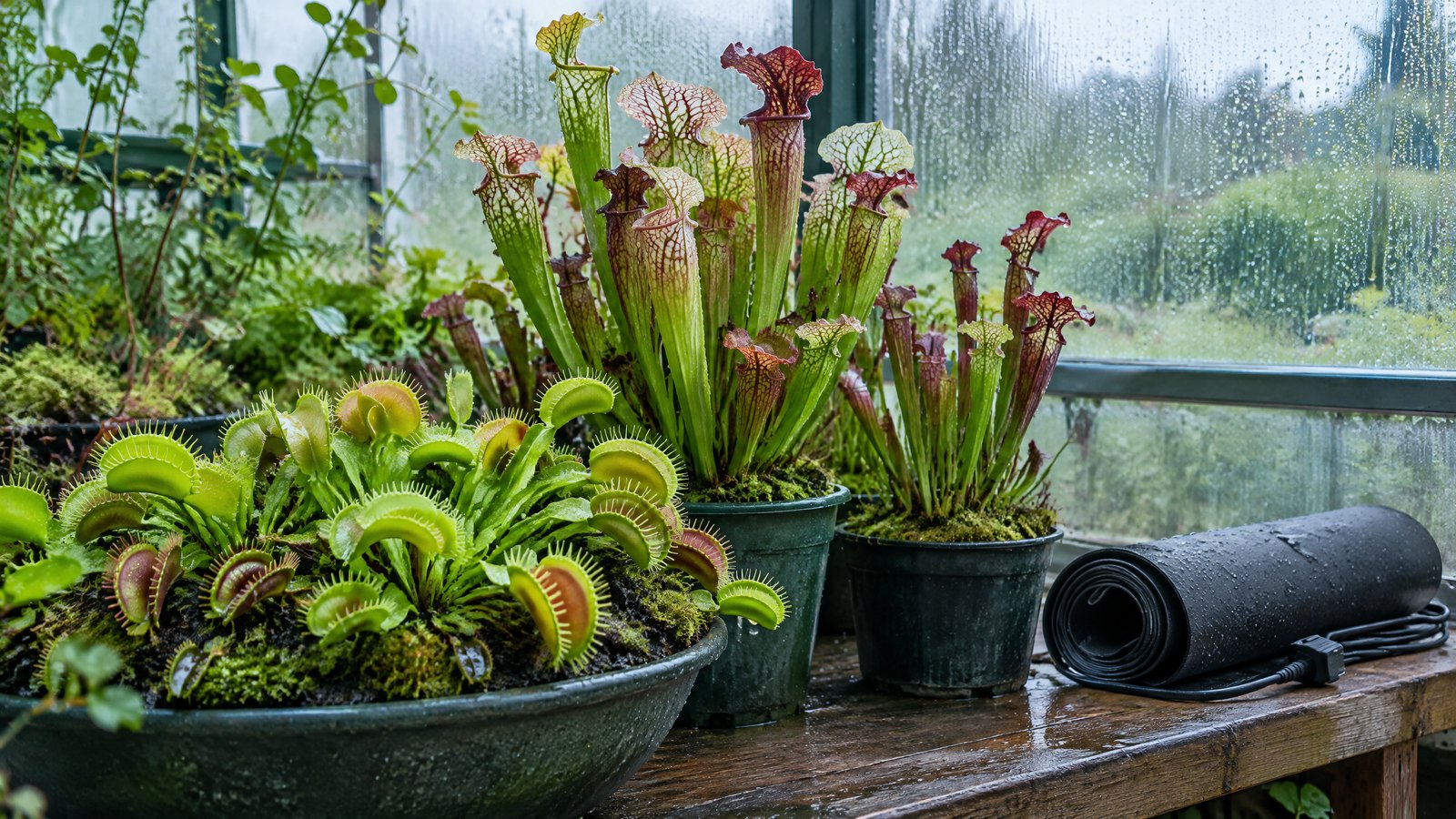
One of the first impulses for an Irish indoor gardener watching winter temperatures drop outside is to reach for an electric propagation heat mat. In Ireland, where central heating is often turned down overnight or homes cool to 14°C–16°C in November, it seems logical that exotic carnivorous plants would appreciate a cosy, heated base.
However, applying bottom heat indiscriminately is one of the quickest ways to destroy a collection of carnivorous plants.
The reason lies in evolutionary biology: carnivorous plants do not belong to a single climatic zone. A heat mat that saves a tropical lowland Nepenthes cutting from shivering will swiftly kill a temperate Sarracenia or Dionaea muscipula.
When Heat Mats Are Disastrous: Temperate Species
Temperate carnivorous plants—including Venus flytraps, all species of *North American pitcher plants (Sarracenia)*, and temperate sundews like Drosera rotundifolia and Drosera filiformis—require a mandatory cold winter dormancy lasting 3 to 4 months between 2°C and 10°C.
During dormancy, the underground rhizome halts foliar growth, conserves carbohydrates, and initiates the cellular preparation required to generate strong spring flower buds and traps.
What Happens When You Put a Dormant Flytrap on a Heat Mat:
- The heat mat warms the wet substrate to 22°C–26°C.
- The roots signal to the rhizome that it is midsummer.
- The plant attempts to push out tender new green leaves.
- However, daylight in Dublin, Cork, or Belfast in December is less than eight hours long, weak, and diffused by heavy cloud.
- Deprived of the intense solar radiation needed to fuel cellular growth at 24°C, the plant enters severe metabolic deficit: it burns more energy through respiration than it can manufacture through photosynthesis.
- The rhizome turns to brown mush within weeks.
Verdict: Never place temperate carnivorous plants on a heat mat during an Irish autumn or winter. Cold is their friend, not their enemy.
When Heat Mats Are Genuinely Useful in Ireland
There are, however, specific botanical scenarios where an electric seedling heat mat with a digital thermostat is an invaluable asset in an Irish home:
1. Tropical Seed Germination
Nepenthes seeds (which are delicate and have short viability windows) and tropical sundew seeds (such as Drosera burmannii or Drosera sessilifolia) germinate best at stable soil temperatures between 24°C and 28°C. In an unheated room in March, wet peat can drop to 12°C, causing seeds to rot before they can sprout.
2. Rooting Cuttings and Propagating Pullings
When taking leaf pullings of Mexican Pinguicula or stem cuttings of Nepenthes, gentle, controlled bottom heat stimulates rapid callusing and root initiation, cutting rooting time in half.
3. Protecting Ultra-Lowland Nepenthes
True lowland tropical pitcher plants (such as Nepenthes bicalcarata or Nepenthes ampullaria) suffer physiological tissue collapse if root temperatures drop below 16°C. If you choose to grow these demanding tropicals in an Irish home, a thermostatically controlled heat mat inside a dedicated grow tent is essential to buffer against chilly winter drafts.
Safe Heating Rules: Avoiding Root Cookery
If you do deploy a heat mat, follow these critical safety precautions:
- Always Use a Thermostat: Never plug a heat mat directly into the mains without a temperature controller. A cheap, unregulated mat sitting beneath a shallow tray of water will heat the standing water like a sous-vide cooker, reaching 35°C–40°C on a mild day and literally boiling the roots.
- Insert the Temperature Probe into the Soil: Do not tape the probe to the mat or leave it dangling in the air. Insert the waterproof sensor directly into the centre of a representative pot at root depth.
- Elevate Trays with an Air Gap: Place small plastic spacers (such as bottle caps or slatted grates) between the heat mat and the plant saucers to allow heat to dissipate evenly without creating extreme localised hot spots.
Summary by Plant Group
| Carnivorous Plant Group | Heat Mat in Irish Winter? | Correct Winter Strategy |
|---|---|---|
| *Venus Flytraps (Dionaea)* | NO (Harmful) | Cold unheated porch/porch (2°C–10°C); barely damp |
| *Trumpet Pitchers (Sarracenia)* | NO (Harmful) | Outdoors or cold greenhouse; fully frost hardy |
| *Temperate Sundews (D. rotundifolia)* | NO (Harmful) | Form winter resting hibernacula; keep cold outdoors |
| *Cape Sundew (Drosera capensis)* | Unnecessary | Normal room temperature (16°C–21°C) on sunny sill |
| *Mexican Butterworts (Pinguicula)* | Unnecessary | Cool, dry windowsill; reduce watering drastically |
| *Highland Nepenthes*** | Unnecessary | Prefer cool nights (12°C–15°C); heating prevents pitchers |
| *Lowland Nepenthes*** | YES (Recommended) | Maintain root zone at 22°C–26°C with thermostat |
| Spring Seed Propagation | YES (Helpful) | Set to 24°C under bright LED lights for rapid sprouting |
Heat solves a measured problem, not every winter problem
A heat mat is a tool for situations where the actual growing area is too cool for a warm-growing species or hybrid. It is not a general upgrade for flytraps, temperate sundews or every Nepenthes. Before adding heat, identify the plant, measure day and night temperatures where the pot sits, and ask whether low light, stale air or overwatering is the more likely limitation.
If a heat mat is appropriate, control it with a thermostat and place a thermometer or sensor where the plant experiences the air temperature. A mat’s surface temperature is not the same as the temperature at the leaves. Avoid allowing a covered enclosure to overheat, and do not place a pot directly on a mat if that creates a permanently hot root zone. Specialist growers use monitored heat for particular lowland or warm-intermediate Nepenthes setups, not as a universal prescription. NECPS Nepenthes cultivation
Continue learning
- Growing Nepenthes in an Irish Home — Match added warmth to the named species or hybrid.
- Carnivorous Plant Terrariums — Use ventilation and a thermostat in any enclosed setup.
- Carnivorous Plants Indoors During an Irish Winter — Decide whether a measured winter temperature problem exists.
Research & sources
These references support the practical and conservation notes on this page.
- Clemson Cooperative Extension — Tropical Pitcher Plants (Nepenthes spp.): Indoor Care: Species and hybrid variation, light, humidity and indoor growing methods.
- New England Carnivorous Plant Society — Basic Nepenthes Cultivation: Lowland, highland and hybrid cultivation distinctions.
- Carnivero — Nepenthes Care Guide: Hybrid tolerance, drainage, light and lack of winter dormancy.
- Tom’s Carnivores — Tropical Pitcher Plants: How to Care for Nepenthes: Species-led rather than one-size-fits-all indoor care.
Frequently Asked Questions
Should I put my Venus flytrap on a heat mat during an Irish winter?
ABSOLUTELY NOT. Heating a Venus flytrap in winter prevents its necessary dormancy. The plant will continue respiring and exhausting stored rhizome sugars while sunlight is critically low, leading to rapid death.
When is a heat mat actually beneficial for carnivorous plants?
Heat mats are valuable for germinating tropical Drosera and Nepenthes seeds, propagating Mexican Pinguicula leaf pullings in cold rooms, and rooting lowland Nepenthes cuttings during winter.
What temperature should a seedling heat mat be set to?
Always use a digital thermostat with a soil probe set to 22°C–25°C. Unregulated heat mats placed directly under shallow carnivorous water trays can easily cook wet roots to 35°C+, causing root death.