How to Grow Carnivorous Plants Indoors During an Irish Winter
Navigating the three Irish indoor winter hazards: short daylight, radiator desiccation, and fungal mould. How to separate dormant species from active tropicals.
By Bog & Bite · Published 25 September 2026
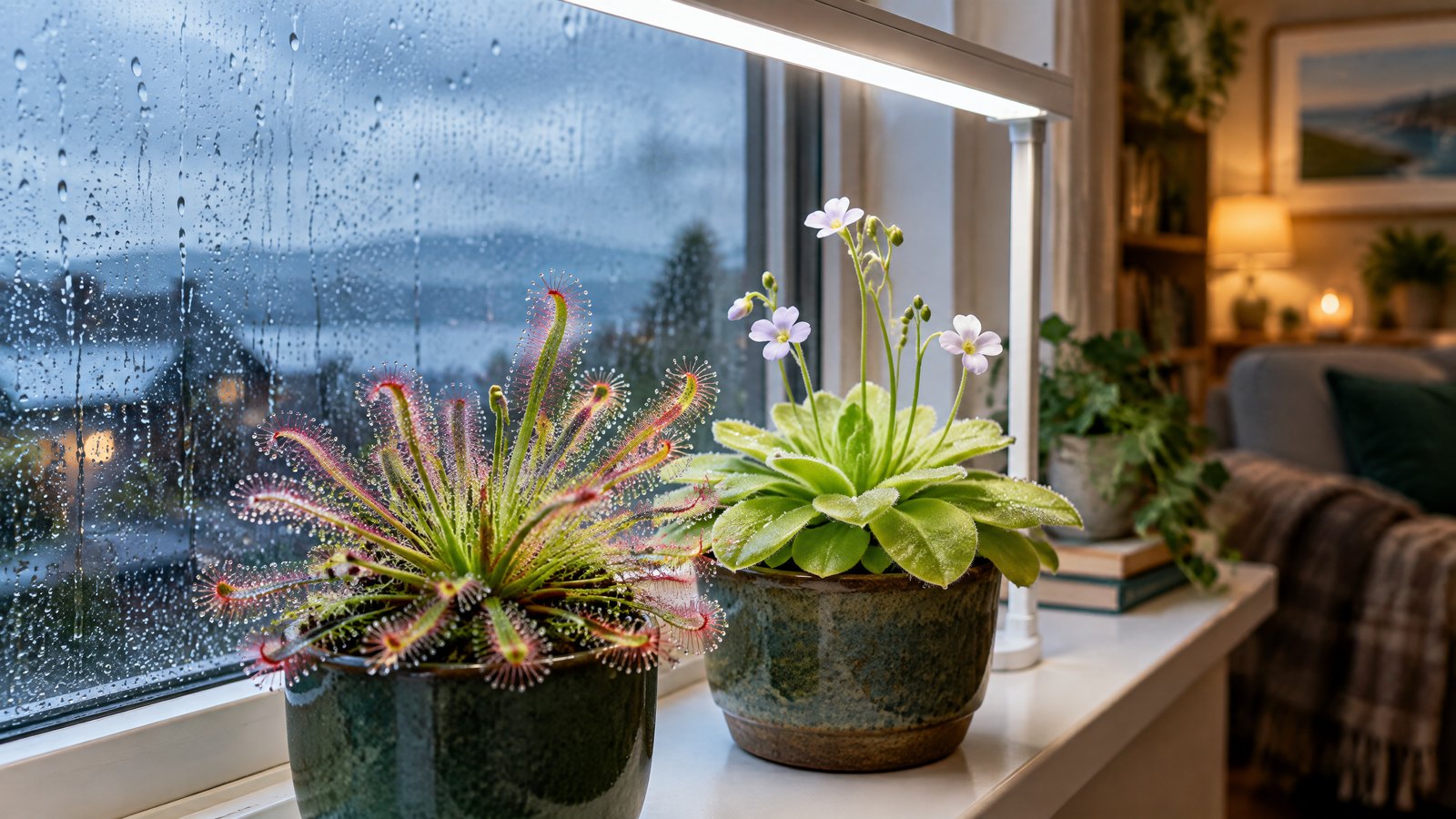
An Irish winter poses a unique paradox for houseplant enthusiasts. Outside, the climate is notoriously damp, overcast, and chilly, with Atlantic gales bringing relentless cloud cover. Yet inside our homes, modern central heating, double-glazed windows, and sealed insulation create an indoor microclimate that is often as arid and desiccating as a desert.
For the carnivorous plant grower, winter requires a strict mental separation: you must treat your temperate outdoor species and your indoor tropical/subtropical species with completely different protocols.
While Venus flytraps and Sarracenia should be resting in an unheated porch or garden mini-bog at 4°C, your indoor plants—including Cape sundews (Drosera capensis), Mexican butterworts (Pinguicula), and tropical pitcher plants (Nepenthes)—require active environmental management to make it through to the spring equinox.
Challenge 1: The Luminous Deficit
In late December, Ireland receives barely 7.5 hours of astronomical daylight, and overcast skies reduce light transmission through window glass to negligible levels.
- The Result: Plants stretch upward, lose their red coloration, drop their sticky dew, and abort new trap formation.
- The Solution: Full-spectrum LED lighting.
- Position a 24W or 36W Sansi full-spectrum LED bulb in a clamp lamp 20 cm to 30 cm above your windowsill collection.
- Connect it to an automatic timer set for 12 to 14 hours daily.
- This provides the consistent, photon-dense light needed for continuous photosynthesis, keeping sundews glistening with dewy mucilage right through the darkest weeks of January.
Challenge 2: The Radiator Desert
Standard domestic heating radiators emit dry, convective heat that drops indoor relative humidity from a comfortable 65% down to 30% or lower.
- The Result: The developing tendrils of Nepenthes dry out before they can swell into pitchers. Sundew tentacles dry into crispy brown needles.
- The Solutions:
- Pebble Trays: Place pots on top of plastic gravel trays filled with water and washed pebbles, ensuring the bottom of the pots sit above the water level. As the radiator warms the water, it evaporates upward, creating a local humid microclimate around the foliage.
- Room Placement: Move sensitive tropicals into kitchens or well-lit bathrooms where showers and cooking naturally elevate ambient air humidity.
- Ultrasonic Humidifiers: A small, inexpensive room humidifier running on low near your plant shelf maintains ambient humidity at 55–65% without wetting window frames.
Challenge 3: Cold Drafts vs Stagnant Air
While central heating dries the air, Irish window glass can be icy cold at night. If pots touch single-glazed panes or sit in drafty sash window channels, root temperatures can plunge to 8°C while tops are warmed by radiators.
- Draft Buffering: Pull pots 10 cm back from the cold glass pane, especially behind drawn curtains at night, which can trap freezing air against the window.
- Ventilation: Avoid sealing plants inside unventilated glass display boxes. Damp soil combined with stagnant air invites grey mould (Botrytis). Ensure rooms receive fresh air during mild afternoon spells.
Winter Water Management
Because indoor evaporation rates change when photoperiods shorten:
- *For Subtropical Sundews (D. capensis):* Continue bottom-watering, but lower the water depth in the saucer from 2 cm down to 0.5 cm.
- *For Mexican Butterworts (Pinguicula): When the plant shifts into its tight, non-carnivorous succulent winter rosette, drain the water saucer completely.* Allow the gritty mix to dry until barely damp, and water lightly from above only once every fortnight.
- *For Nepenthes:* Water thoroughly from above only when the top centimetre of sphagnum moss begins to feel dry to the touch, and empty the drainage saucer.
By monitoring light, humidity, and watering with care, your indoor carnivorous plants will navigate the Irish winter in pristine health, entering spring with lush, vibrant foliage ready to catch early season midges and gnats.
Divide winter care by plant group
A useful winter routine starts by sorting plants into groups rather than moving the whole collection under one rule. Temperate bog plants may slow down or rest in cool conditions. Tropical Nepenthes remain evergreen and should stay frost-free, although shorter days and a cooler room may slow growth. Mexican butterworts may change leaf form and require less water. A warm-growing subtropical sundew can have different needs again.
Measure the actual conditions around the plant: the minimum overnight temperature, how much light reaches it, whether the pot remains waterlogged, and whether the crown or roots are healthy. Use supplementary light or warmth to solve an identified problem, not as a default for every pot. Keep labels with plants so the next winter does not rely on guesswork. RHS winter guidance varies care by plant hardiness and dormancy; Nepenthes sources state that they do not undergo a winter dormancy. RHS growing guide Carnivero Nepenthes guide
Continue learning
- Growing Nepenthes in an Irish Home — Keep tropical pitchers evergreen rather than forcing a dormancy.
- Venus Flytrap Dormancy — Read the separate needs of temperate flytraps.
- Best Grow Lights — Evaluate winter light before changing several variables at once.
Research & sources
These references support the practical and conservation notes on this page.
- Clemson Cooperative Extension — Tropical Pitcher Plants (Nepenthes spp.): Indoor Care: Species and hybrid variation, light, humidity and indoor growing methods.
- New England Carnivorous Plant Society — Basic Nepenthes Cultivation: Lowland, highland and hybrid cultivation distinctions.
- Carnivero — Nepenthes Care Guide: Hybrid tolerance, drainage, light and lack of winter dormancy.
- Tom’s Carnivores — Tropical Pitcher Plants: How to Care for Nepenthes: Species-led rather than one-size-fits-all indoor care.
Frequently Asked Questions
Can I leave Drosera capensis on a windowsill all winter in Ireland?
Yes! Drosera capensis thrives at standard Irish indoor room temperatures (16°C–21°C). Place it on your brightest south-facing windowsill, keep the saucer damp, and provide supplemental LED light to maintain dew production.
How do I counteract central heating radiators drying out the air?
Keep plants grouped together on pebble humidity trays, locate them in naturally humid rooms like bathrooms with frosted south/east windows, or run a small ultrasonic room humidifier on low setting.
How much should I water indoor carnivorous plants in winter?
For actively growing tropicals under LED lights, reduce standing tray water to 0.5 cm. For succulent-phase Mexican Pinguicula, remove standing water completely and water lightly from above only once every 2–3 weeks.