Sundews in Ireland: A Beginner's Guide to Drosera
From our native bog gems to the indestructible Cape sundew. Understand carnivorous dew production, indoor vs outdoor culture, propagation from seed, and legal protection of wild plants.
By Bog & Bite · Published 25 September 2026
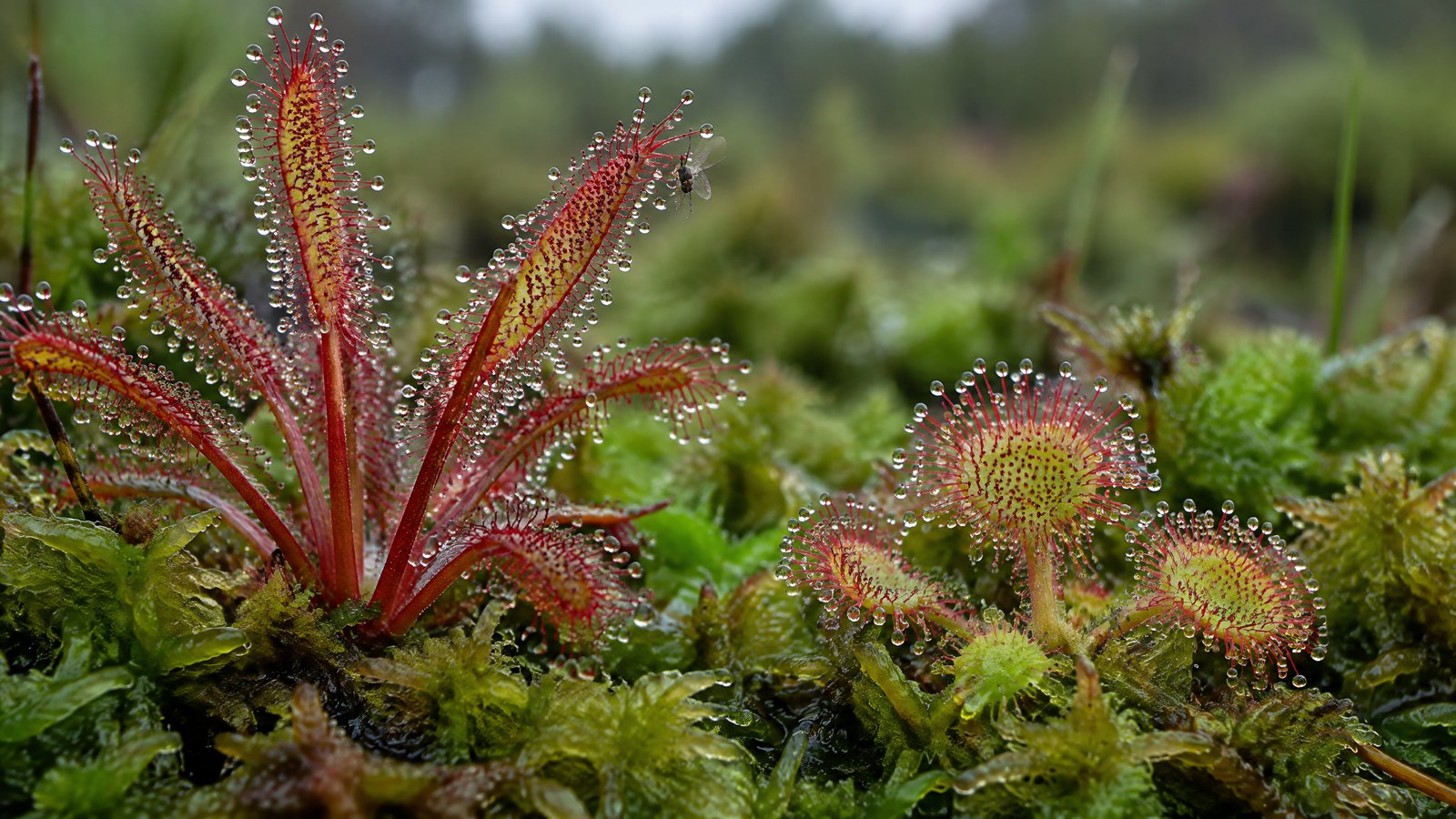
Step onto any pristine raised bog or Atlantic blanket bog in Connemara, Mayo, Kerry, or the Slieve Blooms between June and August, drop to your knees among the wet hummocks of Sphagnum moss, and you will encounter one of Ireland’s most exquisite native treasures: tiny, glistening jewels of carmine and gold, their leaves crowned with drops of liquid that sparkle like morning dew.
These are Drosera—the sundews.
Unlike the snap-trap of the Venus flytrap or the pitfall funnel of the pitcher plant, sundews operate via an active flypaper mechanism. Each leaf blade is covered in hundreds of stalked glandular tentacles. The tip of each tentacle secretes a clear, viscous, mucilaginous droplet composed of acidic polysaccharides and digestive enzymes.
When a midge, fungus gnat, or mosquito brushes against a tentacle, it becomes entrapped in the sticky glue. In its desperate struggle to escape, the insect stimulates adjacent tentacles, which bend inward toward the prey via rapid thigmonastic cellular elongation within minutes, cementing the insect in a puddle of protease, ribonuclease, and phosphatase.
The Three Worlds of Drosera for Irish Growers
Sundews are found across every continent except Antarctica, comprising over 190 species. To cultivate them successfully in Ireland, you must distinguish between the three primary categories:
1. Subtropical Evergreens (The Best Indoor Plants)
- Star Species: Drosera capensis (Cape Sundew), Drosera aliciae, Drosera spatulata.
- Origin: Southern Africa and Australia.
- Irish Culture: Grow indoors on an unobstructed south- or west-facing windowsill year-round. They do not undergo winter dormancy; they remain green, dewy, and hungry 365 days a year.
- The Tray Method: Keep pots standing in 1–2 cm of clean rainwater at all times.
- Bonus: They are the ultimate natural biological control for fungus gnats (sciarid flies) around household pot plants.
2. Native & Cold-Temperate Species (The Outdoor Bog Gems)
- Species: Drosera rotundifolia (Round-Leaved Sundew), Drosera anglica (Great Sundew), Drosera intermedia (Oblong-Leaved Sundew), and Drosera filiformis (Thread-Leaved Sundew).
- The Native Irish Heritage: D. rotundifolia, D. anglica, and D. intermedia are all native to the bogs of Ireland.
- Winter Strategy (The Hibernaculum): In October, cold-temperate sundews withdraw all nutrients from their foliage and form a tight, spherical, winter resting bud called a hibernaculum at the soil surface. This bud can easily survive being frozen in solid ice during Irish frosts. In spring (late April), the hibernaculum unrolls fresh, glandular leaves.
- Irish Culture: Grow outdoors year-round in a mini-bog container or cold greenhouse in full sun. They perform poorly if kept warm indoors during winter.
3. Tuberous and Pygmy Sundews (Advanced Australian Specialists)
- Species from Western Australia that survive brutal summer heat by producing underground tubers or dormant crowns, growing during the cool, wet winter. These are fascinating collector plants that require dedicated lighting setups in Ireland.
Strict Conservation Warning: Respect Wild Irish Bogs
It cannot be overstated: never, under any circumstances, dig up or collect wild sundews from an Irish bog.
Ireland’s peatlands have been severely depleted by industrial peat harvesting and commercial afforestation. The remaining blanket bogs and raised bogs are fragile conservation habitats. Furthermore, wild plants are legally protected under the Wildlife Act (1976) and subsequent amendments; removing them is a criminal offence.
Commercially cultivated sundews propagated from seed or tissue culture in ethical nurseries are widely available, cost only a few euros, and establish far better in pots than traumatised wild specimens.
Propagation: The Infinite Sundew Machine
One of the great joys of growing Drosera capensis is its staggering reproductive vitality:
- From Seed: In summer, the plant produces tall flower scapes bearing dozens of attractive magenta flowers. Once pollinated, the seed pods swell and release thousands of microscopic black seeds. Scatter them directly onto fresh, wet peat/perlite. Keep them warm (20°C–24°C) under bright light, and hundreds of tiny green seedlings will sprout within a month.
- Leaf Cuttings in Water: Snip off a healthy, dewy leaf at the stem. Float it in a clear glass of pure rainwater on a warm, sunny windowsill. Within 3 to 5 weeks, tiny green plantlets with their own miniature roots will sprout directly from the leaf surface! Once they have two or three traps, lift them out and press them gently into damp peat.
Separate cultivated sundews from Ireland’s wild bog flora
“Drosera” is not one care category. A commonly sold subtropical sundew can be kept as a warm-growing windowsill plant, while temperate and native sundews follow the seasonal conditions of their wetland habitats. Identify the species before deciding whether it needs a cool winter rest, a permanent tray or supplemental light.
Ireland has three native sundews: round-leaved, intermediate and long-leaved sundew. Their peatland habitats are vulnerable to drainage, peat cutting and nutrient enrichment. Do not collect plants from bogs or wetlands, and do not introduce cultivated carnivorous plants to natural sites. For cultivated material, choose responsibly sourced nursery stock and match the care to the named plant. Irish Peatland Conservation Council ICPS subtropical Drosera guide
Continue learning
- Butterworts: A Guide for Ireland — See why Mexican butterworts are not bog plants.
- 15 Carnivorous Plant Mistakes — Avoid the water and compost errors shared by many beginners.
- Best Grow Lights — Match supplementary light to the particular sundew and growing place.
Research & sources
These references support the practical and conservation notes on this page.
- International Carnivorous Plant Society — Growing Subtropical Drosera: Care scope for commonly grown subtropical sundews.
- International Carnivorous Plant Society — Growing Mexican Pinguicula: Seasonal leaf forms, water and medium variation in Mexican butterworts.
- Irish Peatland Conservation Council — Carnivorous Plants: Killers in the Bog: Irish native sundews, peatland habitats and conservation context.
- Botanical Society of Britain and Ireland — Drosera rotundifolia species account: Habitat, Irish distribution and peatland pressures for round-leaved sundew.
Frequently Asked Questions
Can I collect wild sundews from an Irish peat bog?
ABSOLUTELY NOT. All native wild plants in Ireland are protected under the Wildlife Act 1976 (and Wildlife Amendment Act 2000). Removing plants from wild habitats is illegal, environmentally damaging, and completely unnecessary when sustainably nursery-propagated stock is readily available.
Why has my sundew lost its glistening sticky dew?
Loss of mucilage is almost always caused by insufficient light intensity or extremely dry air. Move the plant to a brighter, direct-sun location and ensure the pot is standing in 1–2 cm of pure rainwater.
How do you propagate Drosera capensis from seed?
Drosera capensis is self-fertile and produces hundreds of dust-like seeds after flowering. Simply scatter the seeds over fresh, wet peat/perlite, keep under bright light and high humidity at 20°C–24°C, and tiny green seedlings will sprout within 3 to 4 weeks.