Butterworts: The Carnivorous Plant More People Should Grow in Ireland
With their soft succulent rosettes and orchid-like violet blooms, Mexican Pinguicula are the ultimate indoor windowsill carnivore. Heterophylly, mineral substrates, and winter care.
By Bog & Bite · Published 25 September 2026
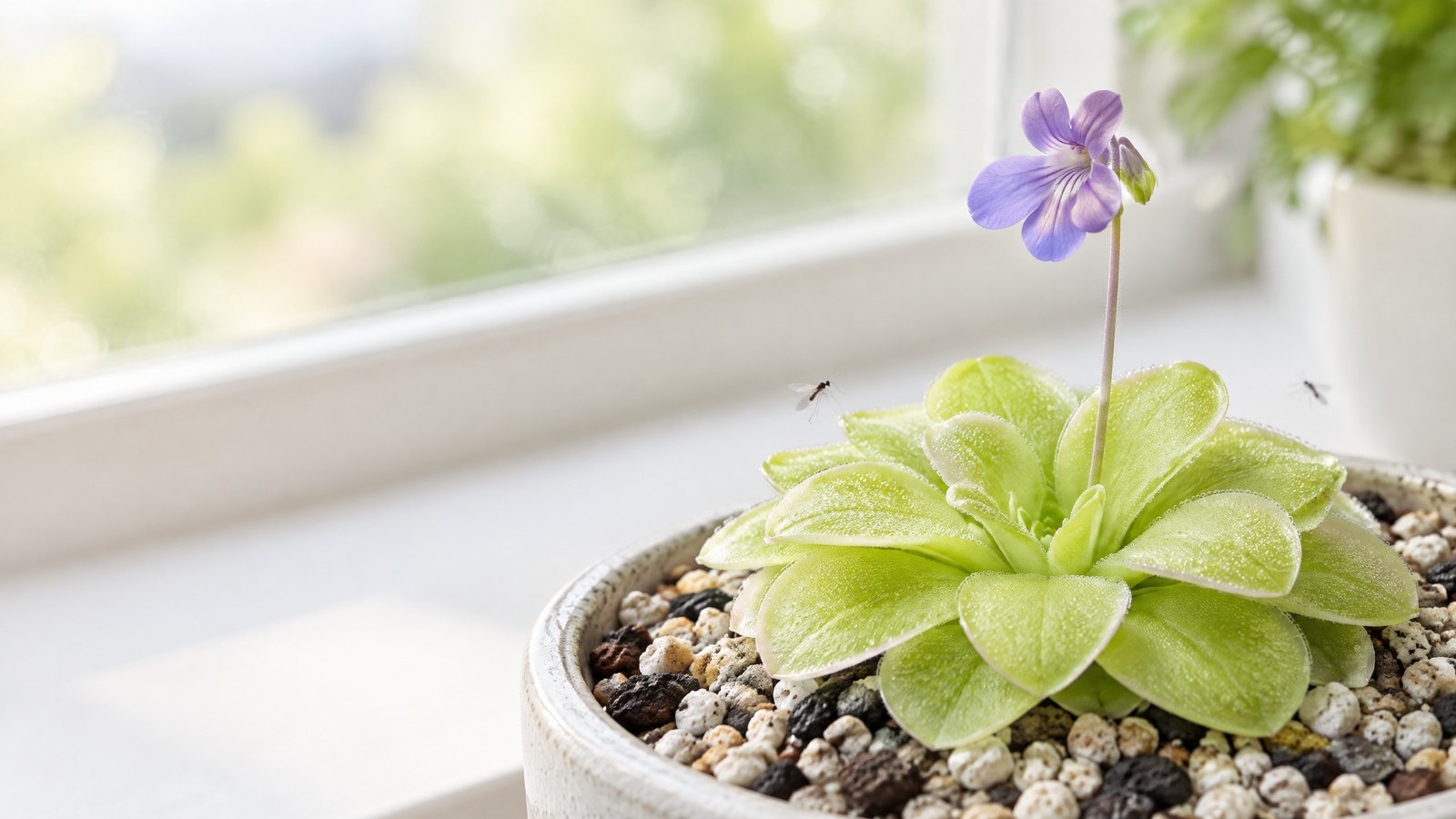
When people think of carnivorous plants, their minds immediately conjure sharp fangs, snapping jaws, or cavernous digestive tubes. Few envision a charming, compact rosette of apple-green, butter-soft succulent leaves topped with delicate, lilac-coloured blossoms that look indistinguishable from wild violets or miniature orchids.
Yet Pinguicula—the butterworts—are among the most sophisticated, efficient, and aesthetically delightful insectivores on Earth.
For the Irish indoor gardener, Mexican butterworts (such as Pinguicula moranensis, P. esseriana, P. agnata, and the ubiquitous hybrid P. 'Tina') represent the holy grail: a carnivorous plant that is genuinely easy to grow inside a typical Irish home. They require less intense light than sundews, thrive on domestic windowsills, eliminate annoying fungus gnats with ruthless efficiency, and flower profusely for months on end.
The Hunting Mechanism: Botanical Flypaper with a Twist
The generic name Pinguicula derives from the Latin pinguis, meaning 'fat' or 'greasy'—a reference to the glossy, glistening sheen that coats the upper leaf surface.
The leaves are populated by two distinct types of microscopic glands:
- Peduncular Glands: Raised on microscopic stalks, these glands secrete droplets of sweet, sticky mucilage that act as adhesive flypaper.
- Sessile Glands: Sitting flush against the leaf surface, these glands produce a potent cocktail of digestive enzymes (including amylase, esterase, and peptidase) when triggered by nitrogenous compounds.
When small insects—such as fruit flies (Drosophila), sciarid flies, or whiteflies—land on the leaf, they are permanently glued down. The leaf margins often curl upward slightly in a slow thigmotropic response, creating a shallow trough that pools digestive fluid around the prey, absorbing dissolved nitrogen directly through the leaf cuticle.
Mexican Butterworts vs Temperate Butterworts
To succeed in Ireland, you must know whether you are growing a Mexican or a temperate butterwort:
1. Mexican Pinguicula (The Indoor Windowsill Champions)
- Species/Hybrids: P. 'Tina', P. 'Weser', P. moranensis, P. cyclosecta, P. gigantea.
- Ecology: They grow on semi-shaded limestone cliffs, mossy rock faces, and gypsum soils in the high mountains of Mexico.
- Heterophylly (Two Leaf Types): This is their secret superpower.
- Summer Phase (Carnivorous): Wide, sticky, spoon-shaped carnivorous leaves that capture insects.
- Winter Phase (Succulent): In late autumn, triggered by shorter days and drier substrate, the plant completely stops making sticky leaves. It transforms into a dense, tight rosette of small, plump, non-carnivorous succulent leaves that store moisture and resist drought!
- Winter Care: In winter, you drastically reduce watering. Keep the compost barely damp, watering lightly only once every two to three weeks. This completely eliminates winter crown rot.
2. Cold-Temperate Butterworts (Outdoor Specialists)
- Species: Pinguicula vulgaris (Common Butterwort, native to Irish bogs), Pinguicula grandiflora (Large-Flowered Butterwort, native to County Kerry and Cork), and Pinguicula alpina.
- Ecology: Native to acidic mountain bogs, wet limestone pavements, and dripping cliff faces in Ireland and Europe.
- Winter Strategy: They form a tight winter resting bud (hibernaculum) that demands freezing winter cold and moisture. They must be grown outdoors or in an unheated cold frame; they will not survive indoors.
The Ideal Substrate for Mexican Butterworts
Do not use heavy, wet 50/50 peat for Mexican Pinguicula. While they can survive in it, they thrive far better in an open, gritty, mineral-heavy substrate that drains instantly:
- The Mineral Mix:
- 30% Perlite
- 30% Horticultural Pumice
- 20% Coarse Silica Sand
- 20% Sifted Sphagnum Peat Moss
- Optional: A teaspoon of crushed limestone chips or oyster shell grit.
Many specialist growers even cultivate Mexican Pinguicula mounted directly on porous limestone rocks (such as tufa stone) sitting in shallow trays of pure rainwater!
Routine Care and Flowering
- Light: Place on an east-facing windowsill receiving gentle morning sun, or a south-facing window with light sheer curtains to soften harsh midday rays. They also thrive under modest 15W–24W desk-mounted LED grow lights.
- Watering: In summer, keep the gritty mix lightly moist using pure rainwater or distilled water. Unlike flytraps, they dislike standing in deep water; keep the water level in the saucer at just 5 mm.
- Flowering: In late winter and early spring—often while still in their succulent phase—Mexican butterworts send up slender flower stems carrying magnificent deep violet, magenta, or white blossoms. Each flower lasts for three to four weeks.
Treat Mexican butterworts as their own group
Mexican Pinguicula are not bog plants. During active growth, many form broader sticky leaves that catch small insects. Some then shift into a smaller succulent leaf form when conditions change. That shift is a cue to reduce water, not a licence to leave the plant bone dry or to apply the same tray routine used for a flytrap.
Use an open, low-nutrient medium and observe the plant’s growth phase. Different species and hybrids respond differently to light, humidity and seasonal cues, so a fixed calendar or universal water depth is less useful than watching leaf form and pot moisture. Bright light and gentle morning sun can be suitable, while a very hot unshaded window may need caution. The International Carnivorous Plant Society provides detailed care notes that distinguish Mexican butterworts from bog-dwelling genera. ICPS Mexican Pinguicula guide
Continue learning
- Sundews in Ireland — Compare Mexican butterworts with temperate bog sundews.
- 15 Carnivorous Plant Mistakes — Avoid treating every carnivorous plant as a permanently waterlogged bog plant.
- Carnivorous Plants Indoors During an Irish Winter — Plan indoor care around the plant’s seasonal leaf form.
Research & sources
These references support the practical and conservation notes on this page.
- International Carnivorous Plant Society — Growing Subtropical Drosera: Care scope for commonly grown subtropical sundews.
- International Carnivorous Plant Society — Growing Mexican Pinguicula: Seasonal leaf forms, water and medium variation in Mexican butterworts.
- Irish Peatland Conservation Council — Carnivorous Plants: Killers in the Bog: Irish native sundews, peatland habitats and conservation context.
- Botanical Society of Britain and Ireland — Drosera rotundifolia species account: Habitat, Irish distribution and peatland pressures for round-leaved sundew.
Frequently Asked Questions
What makes Mexican Pinguicula easier than Venus flytraps indoors?
Mexican Pinguicula thrive in lower, diffused light (morning sun or bright indirect light) rather than scorching outdoor UV. In winter, they enter a dry succulent phase that avoids the need for cold outdoor temperatures or swampy water trays.
What soil mix do Mexican butterworts require?
Unlike acid-loving peat bog plants, Mexican butterworts grow naturally on limestone cliffs and mineral soils. They love an open, gritty, mineral-heavy mix: 1 part peat, 1 part perlite, 1 part pumice, 1 part horticultural sand, and even crushed limestone or coral sand.
How do you propagate butterworts?
Gently pull a mature leaf from the base of the rosette (ensuring the white basal tissue remains intact) and lay it flat on barely damp perlite or peat under a bright light. Tiny plantlets sprout from the base within 2 to 4 weeks.