Dividing Sarracenia in Ireland: A Careful Spring Repotting Guide
A practical, source-backed guide to splitting an overcrowded Sarracenia clump without rushing the season, damaging healthy rhizomes, or losing sight of the water and light conditions that help it recover.
By Bog & Bite · Published 5 October 2026
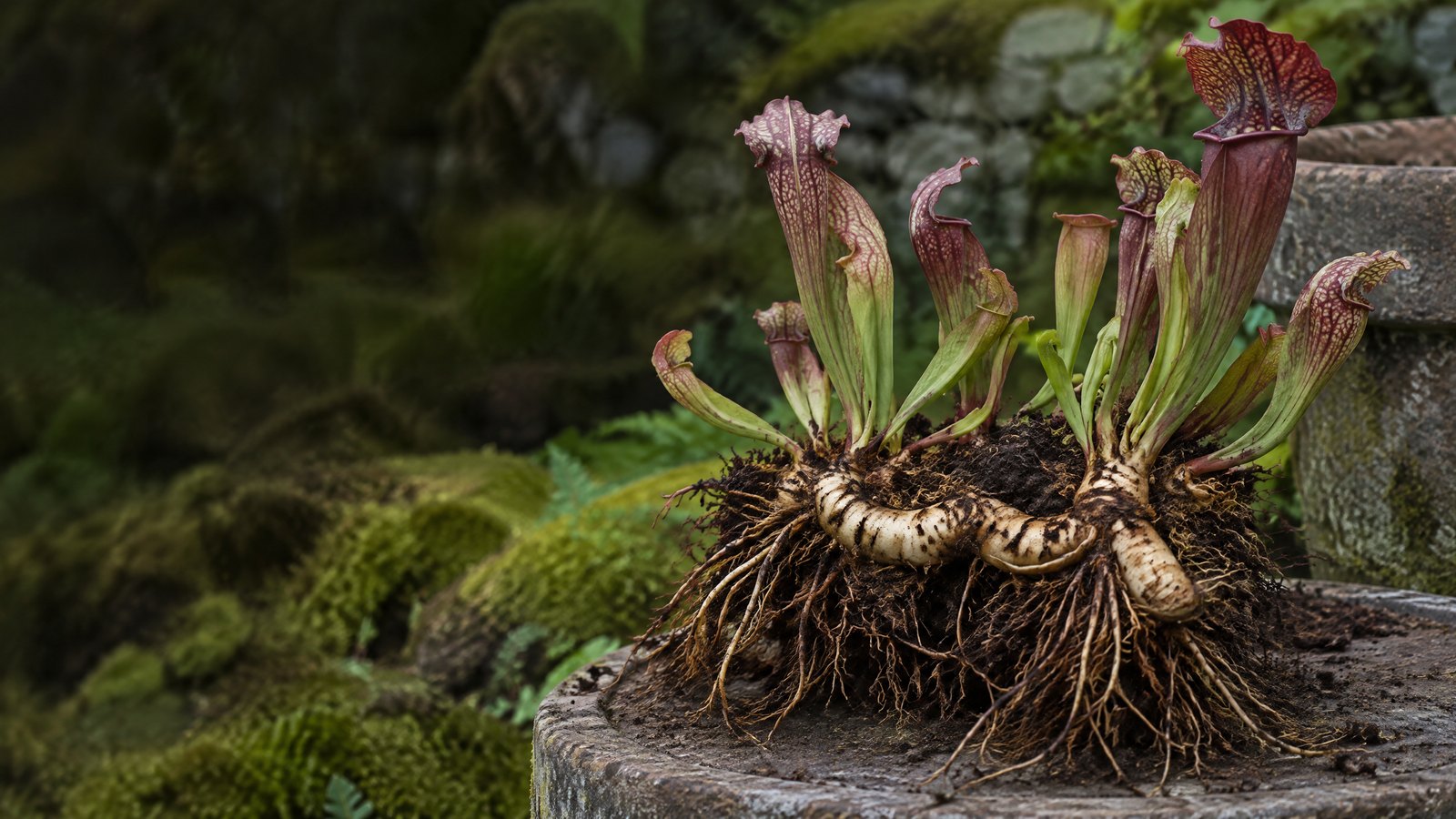
An established Sarracenia clump can become one of the most satisfying plants in an Irish collection: several crowns rise from one rhizome, pitchers fill a patio pot, and a small plant gradually becomes a specimen. That success eventually creates a practical question: when should it be divided?
Division is not a way to produce the greatest possible number of plants from one pot. It is a careful reset for a crowded rhizome, undertaken at a point in the year when the plant can put energy into new roots and pitchers. The International Carnivorous Plant Society (ICPS) recommends dividing Sarracenia just before spring growth begins, when the first signs of waking are visible. For Irish growers, that means watching the plant and its growing space rather than choosing a fixed date from a calendar.
If you are new to this genus, start with the wider Sarracenia in Ireland guide. It explains the outdoor light, water and winter context that still matters after a division has been replanted.
Is this a division job, or simply a tidy-up?
A clump does not need splitting just because it has more than one crown. Consider division when a pot is genuinely congested, several rhizomes are growing over one another, or the plant has reached the edge of its container. The ICPS notes that crowded interiors can make weaker growth while the edges of a clump often make the strongest pitchers.
A different problem calls for a different response. A plant with a soft or discoloured rhizome, persistent pest activity, or a sudden decline needs a health check before it is treated as a routine propagation project. Do not divide simply to make a stressed plant look busy. Remove only fully brown, spent tissue when tidying; green pitchers can still contribute resources to the plant.
Time the work by growth, not by a date
The safest general window is immediately before spring growth begins. Look for the first swelling buds or the first small signs of new growth, then prepare the plant before the flush of pitchers is underway. The ICPS says that plants can survive division at other times, but may take longer to recover.
That timing has a useful practical advantage in Ireland: it lets you inspect the rhizome at the transition from winter rest to active growth, while avoiding a major disturbance in the middle of the growing season. If your plant is still deeply dormant, wait. If new pitchers are already well underway, consider whether the division can reasonably wait until the next appropriate spring window.
Gather the basics before unpotting
Have everything ready so the roots are not left exposed while you search for a pot or water. You need:
- a clean work surface and a label for each finished division;
- a pot only as large as the division needs, with a suitable tray or watering arrangement;
- fresh, specialist carnivorous-plant compost or a medium appropriate for your established setup;
- low-mineral water, such as collected rainwater where available;
- clean secateurs or a knife for a rhizome that will not separate at a natural weak point; and
- gloves if you prefer them for handling wet growing medium.
The RHS advises using compost formulated for carnivorous plants rather than ordinary potting compost, and recommends rainwater whenever possible. Revisit water for carnivorous plants in Ireland before repotting if you are unsure what water will be available for the first few weeks after the job.
Step 1: Lift the clump and read the rhizome
Ease the plant from the pot by supporting the base of the clump rather than pulling individual pitchers. Once it is out, gently loosen enough old medium to see the shape of the rhizome and where the crowns connect. This is the moment to slow down: the aim is to understand the plant's natural points of separation, not to impose an arbitrary number of pieces.
The ICPS describes gently working larger portions back and forth to find weaker, older connections. If a section releases without force and carries healthy roots and several growth points, it is a promising division. When a mature rhizome will not separate cleanly, a clean cutting tool may be appropriate, but make the fewest cuts that achieve a sensible result.
Step 2: Prefer strong divisions over tiny fragments
It can be tempting to split every visible crown apart. In practice, larger sections are more forgiving. The ICPS prefers divisions with roughly three growth points where possible, because they recover more strongly than very small pieces. A single-growth-point piece is not automatically a failure, but it may take time to rebuild.
Keep the best-established portion intact if it is well shaped and healthy; this can be replanted as the principal specimen. Smaller, sound offshoots can become additional plants, provided each has roots and a viable growth point. If a piece is soft, damaged or lacks a convincing growing point, it is better not to pot it up as though it were guaranteed to establish.
Step 3: Clean without stripping useful tissue
Brush away loose, exhausted material and remove old brown leaves around the base. The ICPS specifically highlights the value of clearing brown leaf thatch, which can shelter pests such as mealybugs. Do not force off an old leaf that is still firmly attached, and do not give healthy green pitchers a cosmetic haircut simply to make the division look neat.
Inspect the exposed rhizome and roots before potting. Note any soft sections, pest activity, or unusually unpleasant smell; these are reasons to pause and diagnose rather than proceed with routine aftercare. The goal of division is a clean, open clump with the strongest tissue retained.
Step 4: Replant at a stable depth
Set each division into fresh medium at approximately the height it was growing before. Firm the medium enough to hold the rhizome secure without compacting it into a dense mass, then water it in with low-mineral water. The RHS notes that larger carnivorous plants may need repotting once they outgrow a container, and that a pot only slightly larger than the original is often enough.
Label every pot straight away. It is easy to remember a cultivar, cross or colour form while working at the bench, and surprisingly easy to lose that information once several green shoots emerge in spring.
Step 5: Make recovery conditions boring and consistent
Aftercare is not the moment to experiment with fertiliser, changing media, shade treatments and a new watering routine at the same time. Return the divisions to the light and water conditions appropriate for the plant, while keeping an eye on moisture in smaller pots. The ICPS growing guide emphasises strong sun and low-mineral water for Sarracenia; the RHS also advises monitoring outdoor containers during dry spells.
New divisions may look less dramatic while they re-establish. Judge progress by firm rhizome tissue, new seasonal growth and a stable watering routine, not by trying to force an immediate display of large pitchers. In a particularly exposed position, sensible short-term protection from damaging wind is reasonable, but do not turn a temperate pitcher plant into a permanent indoor houseplant by default.
Mistakes that make a simple division harder
- Dividing in the middle of active growth: the plant can survive it, but spring timing is usually kinder for routine work.
- Making every piece as small as possible: a few robust divisions are often more useful than a tray of weak fragments.
- Using ordinary enriched potting compost: specialist carnivorous-plant medium avoids introducing a routine source of fertiliser.
- Letting the medium dry while you work: organise water, pots and labels before lifting the plant.
- Treating all old pitchers as waste: remove brown, spent tissue, but retain healthy growth where it is still helping the plant.
- Forgetting the label: especially costly when you grow hybrids or more than one species.
A useful companion skill: repotting without division
Not every crowded pot needs to produce extra plants. If the rhizome is still compact and you simply need fresh medium or a larger container, use the same calm preparation and return the plant as one specimen. The mechanics are similar to the approach in repotting a Venus flytrap, but Sarracenia rhizomes and their pitcher growth habit need their own assessment.
For a successful Irish outdoor collection, division is only one part of the picture. Full light, suitable water, a low-nutrient medium and a seasonal rest still matter more than producing a larger number of pots. Keep cultivated plants contained and do not release divisions into bogs, wetlands or other natural habitats.
Continue learning
- Sarracenia in Ireland — Match the division's aftercare to its outdoor growing conditions.
- The complete guide to water — Review water choices before you unpot a plant.
- How to repot a Venus flytrap — Compare the shared preparation steps and the differences in plant structure.
- North American pitcher plants — Return to the plant hub for broader seasonal care notes.
Research & sources
These references support the practical and conservation notes on this page.
- International Carnivorous Plant Society — Dividing Sarracenia Step-by-Step: Spring timing, identifying natural rhizome separation points, retaining stronger divisions and removing brown leaf thatch.
- Royal Horticultural Society — How to grow carnivorous plants: Specialist compost, rainwater, container sizing, ongoing care and division as a propagation method for large Sarracenia clumps.
- International Carnivorous Plant Society — Growing Sarracenia: Light, low-mineral water, seasonal care, pot culture and cautious removal of only brown pitcher tissue.
Frequently Asked Questions
When should I divide Sarracenia in Ireland?
Watch the plant rather than relying on a fixed calendar date. The International Carnivorous Plant Society recommends dividing just before spring growth starts, at the first sign that the plant is waking up. This is often a better guide than a particular month because local conditions and each plant's position differ.
How many growth points should a Sarracenia division have?
Larger divisions generally re-establish more quickly. The International Carnivorous Plant Society notes that divisions with around three growth points tend to recover better than single-growth-point pieces, which may take longer to build strength.
Do I need to fertilise a newly divided Sarracenia?
No extra fertiliser is needed as part of routine division aftercare. Give the plant suitable low-mineral water, an appropriate carnivorous-plant medium and strong light; the International Carnivorous Plant Society cautions that fertiliser in the medium can create problems for mature Sarracenia.
Can I divide a Sarracenia while it is making pitchers?
It may survive division at other times, but recovery can be slower. If there is no urgent health reason to intervene, wait for the spring waking-up period rather than interrupting active seasonal growth.