The Complete Guide to Water for Carnivorous Plants in Ireland
Water is the single most critical factor determining life or death for carnivorous plants. Understand dissolved minerals, Irish regional tap water variations, TDS testing, and pure water sourcing.
By Bog & Bite · Published 25 September 2026
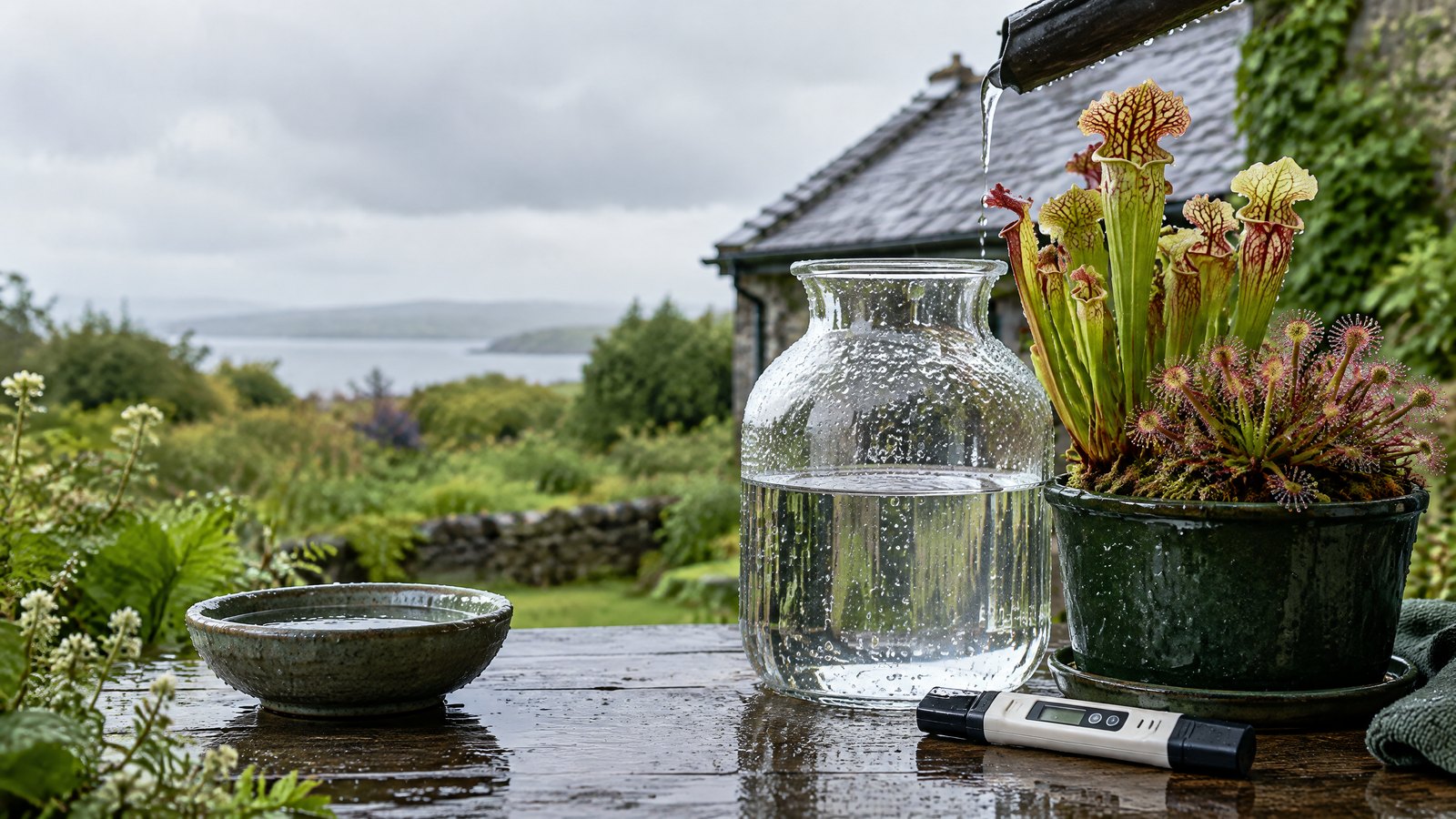
If you take only one horticultural principle away from this entire website, let it be this: water quality is a central part of successful carnivorous-plant care.
In traditional gardening, tap water is universally accepted. Garden plants, brassicas, roses, and ordinary houseplants have evolved complex root mechanisms capable of filtering and utilizing dissolved calcium, magnesium, sulfates, and carbonates.
Carnivorous plants, however, evolved exclusively in ombrotrophic peat bogs, quartzite seepages, and nutrient-stripped sands where the only water supply is direct precipitation. Their roots are adapted to low-nutrient habitats, and repeated mineral build-up in the growing medium can be harmful. When exposed to mineral-heavy water, salts accumulate inside the potting substrate, drawing moisture out of the plant cells via reverse osmosis and chemically burning the root tips.
To keep these plants alive in Ireland, you must understand what is in your water, how to measure it, and how to obtain water that mimics a pristine bog.
What Is TDS and Why Does It Matter?
TDS stands for Total Dissolved Solids. It is a measure of the dissolved inorganic ions—such as calcium (Ca²⁺), magnesium (Mg²⁺), sodium (Na⁺), potassium (K⁺), bicarbonate (HCO₃⁻), and chloride (Cl⁻)—present in a given volume of water, expressed in parts per million (ppm) or milligrams per litre (mg/L).
A TDS meter provides a screening reading, not a universal pass/fail verdict. It measures how much material is dissolved, not which compounds are present. Prioritise rainwater or another low-mineral source; treat an unexpectedly high or changing reading as a reason to investigate the supply and medium rather than as a precise prediction of failure.
A simple digital TDS meter (which measures the electrical conductivity of the water and converts it to ppm) costs less than €15 online and is the single most valuable tool any Irish carnivorous plant grower can own.
The Reality of Irish Tap Water: Why Location Is Everything
One of the most dangerous pieces of advice shared on social media is the blanket claim: "Irish tap water is great because it rains so much here."
The truth is that Ireland’s geological bedrock varies dramatically across the island, and public drinking water supplies differ fundamentally depending on whether the source is surface water (reservoirs, upland lakes) or groundwater (limestone aquifers, boreholes).
- The Peaty Upland Surface Waters (Soft Water):
- Examples: Parts of County Wicklow, Dublin City fed by the Poulaphouca / Roundwood reservoirs, parts of Connemara, Kerry, and West Cork.
- Typical TDS: 25 ppm to 70 ppm.
- Carnivorous Suitability: In some of these areas, tap water is remarkably soft and can occasionally be used in an emergency, or even long-term for hardy outdoor Sarracenia if flushed by frequent rain.
- The Midland Limestone Aquifers (Very Hard Water):
- Examples: Kildare, Meath, Westmeath, Laois, Kilkenny, Galway City and County, parts of Cork and Limerick.
- Typical TDS: 250 ppm to over 500 ppm!
- Carnivorous Suitability: Use caution. Mineral-heavy water can raise dissolved-mineral levels in a small pot over time and may stress mineral-sensitive carnivorous plants. The actual effect depends on the supply, growing medium and watering method, so use a suitable low-mineral source rather than relying on a county-level assumption.
Never assume your tap water is safe based on what someone in a different county reports. Always test your own kitchen tap with a calibrated digital meter.
Safe Sources of Pure Water in Ireland
1. Rainwater (The Natural Gold Standard)
Ireland receives between 750 mm and 1,500 mm of rainfall annually across the lowlands, and over 2,000 mm in western mountainous regions. Rainwater is free, abundant, and naturally low in dissolved minerals.
- Typical TDS: 5 ppm to 20 ppm.
- Best Practice: Collect from clean gutters into a covered plastic water butt. Avoid water collected from brand-new concrete tiles, unsealed zinc flashings, or flat asphalt roofs that leach petroleum oils and minerals.
2. Reverse Osmosis (RO) Water
Reverse osmosis systems force mains tap water through a semi-permeable membrane that strips out 95% to 99% of all dissolved inorganic solids.
- Typical TDS: 0 ppm to 8 ppm.
- Sourcing: You can purchase a compact 3-stage or 4-stage domestic RO unit for your home for €70–€120. Alternatively, many aquatic aquarium shops across Ireland sell pure RO water by the 25-litre drum for approximately €3 to €5.
3. Deionised / Distilled Water
True distilled water is produced by boiling water and capturing the condensed steam. Deionised water is passed through ion-exchange resin beds that bind all charged mineral ions.
- Typical TDS: 0 ppm to 2 ppm.
- Sourcing: Available in 5-litre containers in Irish hardware stores, motor factors (sold as battery top-up water or car coolant water), and some supermarkets.
- Warning: Ensure the label explicitly states deionised or distilled, with no added fragrances, softening agents, or detergents (often found in ironing waters).
4. Condenser Tumble Dryer & Dehumidifier Water
Many Irish homes run dehumidifiers in winter or use heat-pump condenser tumble dryers. The water collected in their collection tanks is condensed atmospheric humidity and is virtually mineral-free.
- Typical TDS: 5 ppm to 15 ppm.
- Precautions: Tumble dryer water may carry microscopic fabric lint or fragrance residues from laundry detergents. Run it through a coffee filter before using. Dehumidifier water is generally very clean, provided the collection tank is washed regularly to avoid mould spores.
The Three Deadly Water Myths
- Myth 1: "Letting tap water sit overnight makes it safe."
- The Science: Leaving water in an open jug allows chlorine gas to dissipate into the air. However, it does not remove a single milligram of calcium, magnesium, heavy metals, or chloramines. In fact, as water slightly evaporates, the TDS actually rises!
- Myth 2: "Boiling water removes hardness."
- The Science: Boiling precipitates some temporary bicarbonate hardness as limescale on the bottom of your kettle, but it evaporates pure steam, leaving the remaining liquid more concentrated in permanent mineral salts.
- Myth 3: "A Brita filter pitcher makes tap water pure."
- The Science: Carbon jug filters are designed to improve drinking taste by removing chlorine and trace organics. They do not remove all dissolved minerals. A filter jug's performance depends on the model and cartridge; it should not be assumed to make a hard-water supply suitable for mineral-sensitive carnivorous plants. Check the manufacturer's specifications and use a suitable low-mineral source where needed.
Safe Water Summary Matrix
| Water Source | Typical Irish TDS | Safety Level | Verdict |
|---|---|---|---|
| Clean Rainwater | 5 – 25 ppm | Safe (Optimal) | The natural, free choice for all Irish collections |
| Reverse Osmosis (RO) | 0 – 10 ppm | Safe (Optimal) | Reliable year-round backup for indoor collections |
| Distilled / Deionised | 0 – 3 ppm | Safe (Optimal) | Excellent for small collections; check no additives |
| Dehumidifier Water | 5 – 20 ppm | Safe | Filter out dust; wash tank regularly |
| Tumble Dryer Condenser | 10 – 30 ppm | Cautious | Filter lint; only use unscented laundry loads |
| Soft Tap Water (Wicklow/Upland) | 25 – 60 ppm | Marginal | Acceptable in emergencies; monitor with meter |
| Hard Tap Water (Limestone) | 180 – 500+ ppm | Use caution | Check the named supply and favour a lower-mineral alternative |
| Boiled Tap Water | Higher than tap | Toxic | Worse than untreated tap water |
| Standard Jug Filter | 120 – 350 ppm | Toxic | Insufficient mineral reduction |
Use a meter as a screening tool, not a verdict
A TDS meter is useful because it can alert you that a water source deserves closer attention, but it does not identify the minerals or other dissolved substances producing the reading. Two water samples with a similar number can contain different compounds. Treat the measurement as one practical check alongside the source of the water, the plant genus, the condition of the medium and any evidence of mineral accumulation.
For a new collection, the conservative route is to use rainwater where it is collected and stored cleanly. Distilled, deionised or reverse-osmosis water are common alternatives. Do not assume that a household filter creates suitable water, and do not use an Ireland-wide or county-wide figure in place of the results for your own supply. Uisce Éireann provides address or Eircode-based water-quality information, while the RHS explains why repeated use of harder water can build minerals up in compost. Uisce Éireann hard-water information RHS water collection guide
Continue learning
- Rainwater for Carnivorous Plants — Build and maintain a clean rainwater collection setup.
- Irish Tap Water for Carnivorous Plants — Check the water supply at your own address rather than relying on a county-wide rule.
- Venus Flytrap Soil — Understand how water and low-nutrient medium work together.
Research & sources
These references support the practical and conservation notes on this page.
- Royal Horticultural Society — How to grow carnivorous plants: Specialist compost, rainwater and species-specific growing guidance.
- Royal Horticultural Society — Collecting, storing and reusing water: Rainwater collection, water-butt hygiene and soft-water guidance.
- Uisce Éireann — Hard water: Address-level information on Irish public water hardness.
- New York Botanical Garden — Venus Flytrap Houseplants: Low-mineral water and specialist medium guidance for Dionaea.
Frequently Asked Questions
What TDS reading is safe for carnivorous plants?
As a rule of thumb, water under 30 ppm (parts per million) TDS is safe for all carnivorous plants. Water under 50 ppm can be used safely for robust species like Sarracenia and Drosera capensis if flushed occasionally. Water above 80 ppm will reliably poison plants over time.
Does boiling Irish tap water make it safe for flytraps?
NO! Boiling water evaporates pure H2O as steam, concentrating the dissolved mineral salts and increasing the TDS reading. It sterilises bacteria but makes the mineral toxicity significantly worse.
Can I use water from a domestic Brita filter jug?
Generally no. Standard carbon and ion-exchange filter jugs are designed to reduce chlorine and temporary taste odours, not eliminate all dissolved inorganic solids. Often, they exchange calcium ions for sodium ions, which is equally toxic to bog plants. Always verify with a calibrated TDS meter.