Can You Use Irish Tap Water for Carnivorous Plants? Regional Realities
How does Irish tap-water quality vary for carnivorous plants? We explain why a local supply report and a suitable low-mineral source matter more than county-wide assumptions.
By Bog & Bite · Published 25 September 2026
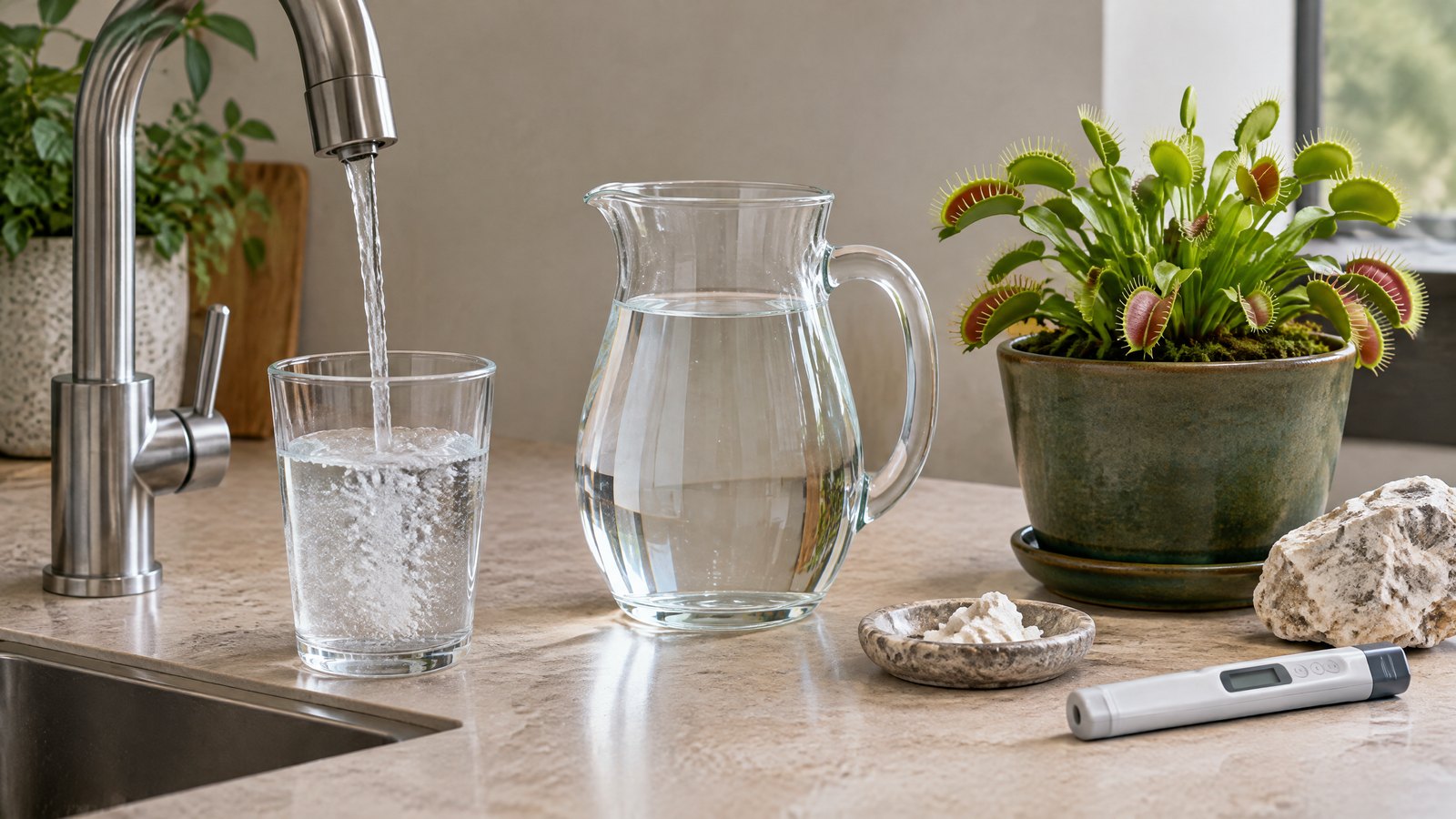
Few questions generate as much fierce debate on Irish gardening forums and social media groups as this: "Can I just use tap water for my Venus flytrap?"
One grower from Bray or Wicklow posts: "I've used kitchen tap water for two years and my plants are thriving!" Meanwhile, a grower from Kilkenny, Mullingar, or Galway replies: "I watered my flytrap with tap water for three weeks and it turned black and died!"
Both growers are telling the absolute truth.
The explanation lies in the complex geology of the island of Ireland. Depending on which county you live in, your municipal tap water is derived either from granitic, peaty upland surface reservoirs (soft water) or from deep limestone subterranean aquifers (exceptionally hard water).
To keep carnivorous plants alive without guessing, you must understand the chemistry of Irish water supplies.
The Chemical Threat: Cation Accumulation in Peat
Why does mineral content matter so intensely to bog plants?
- Osmotic Shock: Plant root cells absorb water through osmosis, moving from low solute concentrations to higher internal cellular concentrations. When tap water contains high concentrations of dissolved calcium (Ca²⁺), magnesium (Mg²⁺), and sodium (Na⁺), water is pulled out of root cells, resulting in physiological drought despite soaking wet soil.
- Substrate Neutralisation: Sphagnum peat moss relies on an acidic pH (3.5 to 4.5) to suppress bacterial rot and maintain nutrient availability. Alkaline tap water laden with calcium carbonate (CaCO₃) acts as an agricultural liming agent. Over a few months of bottom-watering, the peat pH rises above 6.0, triggering rapid bacterial decomposition of the peat and fatal root rot.
The Geological Map of Irish Water Quality
To understand what comes out of your tap, look beneath your feet:
Group 1: The Acidic Upland Waters (Low Mineralisation / Soft Water)
- Bedrock: Granite, sandstone, quartzite, and blanket peat.
- Regions: The Wicklow Mountains, parts of South Dublin, West Cork, the mountains of Kerry, Connemara, western Mayo, and the Mourne Mountains in Co. Down.
- Water Source: Direct rainfall running into surface reservoirs (e.g., Roundwood Reservoir, Poulaphouca / Blessington, Silent Valley).
- Typical TDS: 25 ppm to 65 ppm.
- The Verdict for Carnivores: Marginally safe to acceptable. In these specific soft-water areas, tap water can be used safely during summer dry spells, particularly for robust outdoor Sarracenia that are naturally leached by subsequent rains.
Group 2: The Carboniferous Limestone Plain (High Mineralisation / Very Hard Water)
- Bedrock: Dense Carboniferous limestone that dissolved over millions of years to form Ireland’s fertile midland plains and karstic regions (such as the Burren).
- Regions: Kildare, Meath, Westmeath, Offaly, Laois, Kilkenny, Tipperary, Carlow, East Galway, Roscommon, Limerick, and inland Cork.
- Water Source: Deep groundwater boreholes, wells, and lowland limestone rivers (e.g., the Shannon, Boyne, Barrow).
- Typical TDS: 200 ppm to 550+ ppm!
- The Verdict for Carnivores: Not a routine choice. A mineral-rich supply can increase mineral levels in a small pot over time and may be unsuitable for mineral-sensitive carnivorous plants. Confirm the actual supply with a current report or appropriate testing, and use rainwater, distilled, deionised or reverse-osmosis water when a low-mineral source is needed.
How to Check Your Local Water Quality
Do not rely on regional guesswork:
- The Gold Standard: A Digital TDS Meter.
- A handheld digital TDS meter costs around €15. Fill a clean glass with tap water, dip the probe, and read the digital screen.
- Use the number cautiously: a meter is useful for screening, but it does not identify the dissolved substances.
- Check the supply: use address-level Uisce Éireann information for a public supply, or suitable testing for a private one.
- Choose conservatively: rainwater, distilled, deionised or reverse-osmosis water are common options for mineral-sensitive carnivorous plants.
- Irish Water (Uisce Éireann) Drinking Water Reports:
- Visit the Uisce Éireann portal and enter your Eircode to download the comprehensive drinking water quality report for your public water supply zone.
- Look for parameters listed under Conductivity (at 20°C, measured in µS/cm) or Hardness (measured in mg/L CaCO₃ or French/German degrees).
- As an approximate rule of thumb: TDS (ppm) ≈ conductivity (µS/cm) × 0.65.
The Flushing Protocol: If You Must Use Marginal Tap Water
If you reside in a soft-water area (TDS 40–60 ppm) and run out of rainwater during a rare Irish heatwave:
- Water the plants from above rather than bottom-watering in trays. This prevents mineral salts from wicking upward and crusting at the soil surface.
- Allow water to flow freely through the drainage holes into a bucket and discard the effluent immediately.
- As soon as rain returns, place the plants outdoors in a heavy Atlantic downpour to thoroughly leach any accumulated salts out of the substrate.
Verify the supply you actually use
Irish water quality varies by supply zone. An address-level report is more useful than a county stereotype, and a TDS meter is best treated as a quick screening tool rather than a chemical analysis. It cannot tell you which dissolved substances are present, whether a private well has changed, or whether a particular plant and medium are accumulating minerals over time.
Check Uisce Éireann’s water-quality information for a public supply, and if you depend on a private source, consider a suitable water test rather than assuming local water is soft or hard. Where the water is not appropriate for mineral-sensitive carnivorous plants, a clean rainwater system is often the simplest alternative. Boiling is not a dependable route to suitable soft water; the RHS advises that it generally does not remove enough calcium for plants that need soft water. Uisce Éireann water results RHS water guide
Continue learning
- Rainwater for Carnivorous Plants — Create a dependable low-mineral backup.
- Water for Carnivorous Plants — Understand what a meter can and cannot tell you.
- Venus Flytrap Soil — Refresh medium if mineral build-up is suspected.
Research & sources
These references support the practical and conservation notes on this page.
- Royal Horticultural Society — How to grow carnivorous plants: Specialist compost, rainwater and species-specific growing guidance.
- Royal Horticultural Society — Collecting, storing and reusing water: Rainwater collection, water-butt hygiene and soft-water guidance.
- Uisce Éireann — Hard water: Address-level information on Irish public water hardness.
- New York Botanical Garden — Venus Flytrap Houseplants: Low-mineral water and specialist medium guidance for Dionaea.
Frequently Asked Questions
Can I use Dublin tap water for my carnivorous plants?
It depends on the current supply and its published water-quality information. Do not classify a supply by a city or county label alone: check the relevant Uisce Éireann report for a public supply, or test a private supply appropriately. For mineral-sensitive carnivorous plants, rainwater, distilled, deionised or reverse-osmosis water are the more cautious choices when suitability is uncertain.
What is the fastest way to know if my tap water is safe?
Purchase a digital TDS (Total Dissolved Solids) meter for €12–€15 online. Dip it into a clean glass of tap water. If the reading is under 40 ppm, it is safe; if it is over 80 ppm, do not use it.
Will boiling Irish tap water remove the minerals?
No! Boiling removes dissolved gases and kills microbes, but evaporates pure water as steam, leaving the mineral concentration (calcium and magnesium) even higher than before.