What Soil Do Venus Flytraps Actually Need? The Truth About Peat & Substrates
How to choose a low-nutrient growing medium for a Venus flytrap. Substrate recipes, horticultural perlite, silica sand, and the Irish peat debate.
By Bog & Bite · Published 25 September 2026
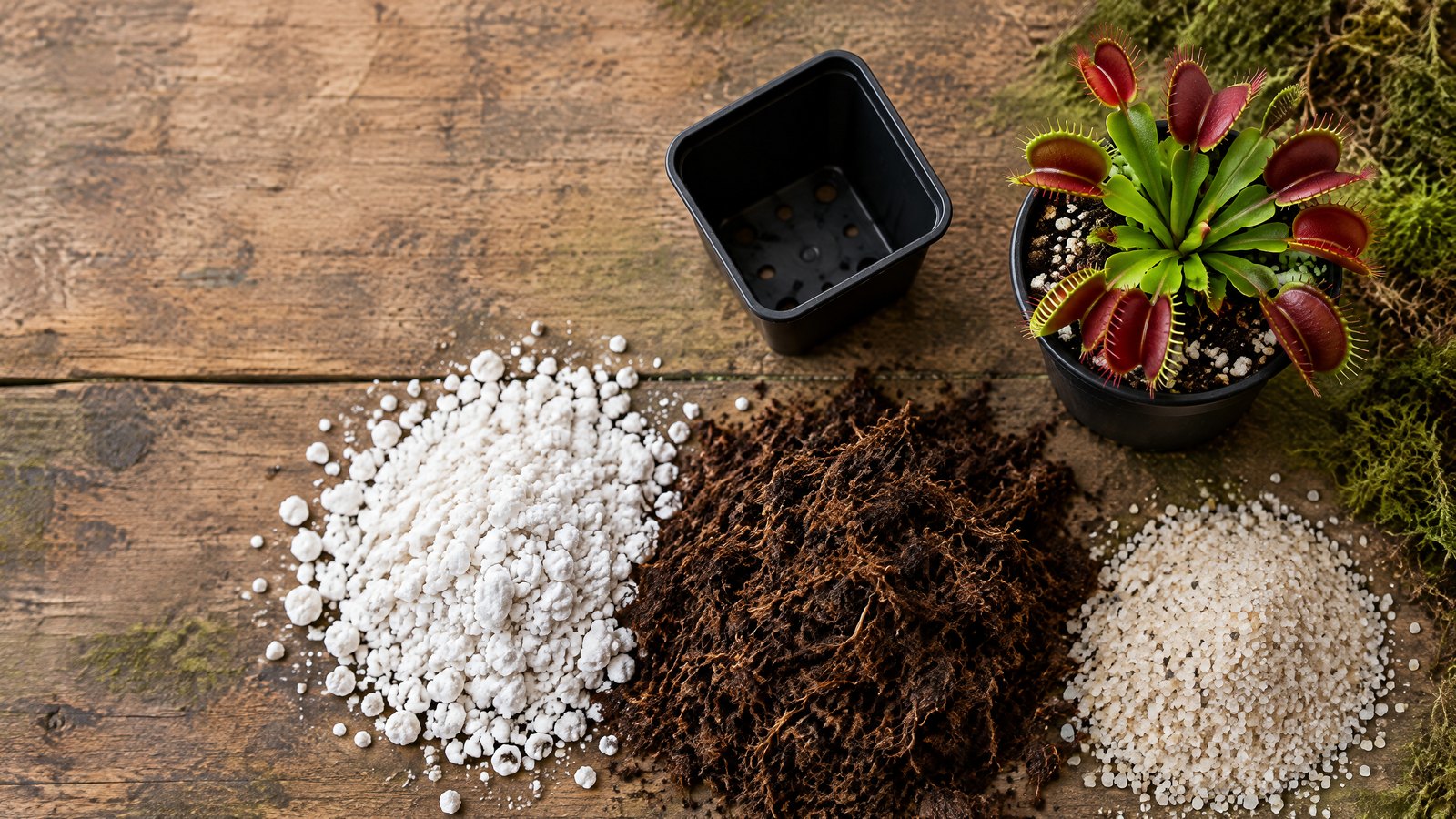
To understand why ordinary potting soil instantly kills a Venus flytrap, one must understand the evolutionary compromise that created carnivorous plants in the first place.
Over tens of millions of years, plants inhabiting nutrient-deficient bogs abandoned their reliance on root-based nutrient uptake. Normal plants invest massive metabolic energy into root hairs that extract nitrogen, phosphorus, and potassium from rich loam. Carnivorous plants evolved the anatomical wizardry of modified leaf traps to secure those precious nutrients directly from animal prey instead.
Consequently, their root systems lost the biochemical mechanisms required to regulate osmotic uptake in mineral-rich environments. If you plant a Venus flytrap in Miracle-Gro, multipurpose garden compost, or topsoil, the high concentration of mineral salts pulls water violently out of the root tissue, causing catastrophic cell collapse.
To keep a flytrap alive, you must recreate the physical and chemical properties of an acidic, nutrient-void bog.
The Essential Criteria for Carnivorous Substrates
Any growing medium used for Venus flytraps must satisfy four non-negotiable rules:
- Zero Added Fertiliser: The packaging must state 100% pure moss peat, with no added NPK, wetting agents, or plant food.
- Naturally Low pH: The substrate must be strongly acidic, ideally with a pH between 3.5 and 4.8.
- Exceptional Water Retention with Aeration: It must remain continuously moist without compacting into an anaerobic, airless sludge.
- Zero Free Calcium / Lime: Never use builders' sand, horticultural grit derived from limestone, or alkaline gravels.
The Classic Recipes
Recipe 1: Standard 50/50 Peat and Perlite Mix (The Gold Standard)
- 50% Pure Sphagnum Peat Moss (unfertilised, sifted)
- 50% Horticultural Perlite
Why it works: Sphagnum peat provides natural acidity, high cation-exchange capacity, and moisture retention. Perlite (expanded volcanic glass) is chemically inert, adds aeration, and prevents the peat from compacting over time, ensuring healthy oxygen exchange around the rhizome.
Recipe 2: Peat and Coarse Silica Sand (60/40)
- 60% Pure Sphagnum Peat Moss
- 40% Coarse Horticultural Silica Sand (1–3 mm grain size)
Why it works: Silica sand (SiO₂) adds weight to the pot, making it far less prone to blowing over in blustery Irish patio conditions. Crucial Warning: You must use pure quartz silica sand or silver sand. Never use red building sand, pit sand, or play sand, which frequently contain ground sea shells or limestone dust that will leach calcium carbonate. Test with vinegar: if it fizzes, it contains lime and will kill your plants!
Recipe 3: Long-Fibre Sphagnum Moss (LFS)
- 100% Dried New Zealand or Chilean Sphagnum Moss (rehydrated in rainwater)
Why it works: Live or dried long-fibre sphagnum is naturally antiseptic, exceptionally airy, and impossible to over-compact. It is widely favoured by specialist growers for sick plants recovering from root rot, though it tends to break down after 18–24 months and requires more frequent repotting than peat-perlite mixes.
How to Mix and Prepare Your Substrate
- Pre-wetting is Mandatory: Dry sphagnum peat is naturally hydrophobic. If you put dry peat into a pot and pour water on top, the water will run down the sides while the core remains bone dry.
- Place your dry peat and perlite into a clean bucket or plastic tub.
- Pour pure rainwater or distilled water over the ingredients.
- Put on gloves (and ideally a dust mask to avoid inhaling fine perlite dust) and knead the mixture thoroughly with your hands until it absorbs moisture evenly, resembling moist, crumbly chocolate cake.
- Squeeze a handful: a few drops of water should squeeze out between your knuckles. If it pours water like a saturated sponge, let it drain slightly before potting.
The Peat Dilemma in Modern Ireland
No discussion of carnivorous plant media in Ireland can ignore the environmental reality of peatlands. Irish raised and blanket bogs are vital carbon sinks and delicate ecosystems that have suffered immense degradation from industrial extraction. Bord na Móna has ceased commercial harvesting, and garden centres are rapidly transitioning to peat-free alternatives for ordinary bedding plants.
For flytraps and similar bog plants, do not assume that a general-purpose peat-free product is suitable. Some mixes contain composted organic material, fertiliser or other components that do not match the low-nutrient, acidic conditions these plants need. Evaluate the documented ingredients and the needs of the particular species instead of treating every peat-free or bark-containing medium as the same.
For the ethical Irish hobbyist, two realistic paths exist:
- Check peat sourcing carefully: If choosing peat, look for transparent supplier sourcing information and avoid unsupported sustainability claims. Consider whether an alternative medium is suitable for the particular species.
- Cultivate Live Sphagnum Moss: Live Sphagnum can be farmed sustainably in shallow plastic trays outdoors in Ireland using only rainwater. It reproduces rapidly and provides the ultimate natural, perpetual, and peat-free substrate for flytraps, sundews, and pitcher plants.
Judge materials by what they add to the root zone
The key principle is not a magic ratio. Flytraps need a low-nutrient, acidic, open medium that stays moist without becoming airless. Ordinary multi-purpose compost is unsuitable because it is designed to feed conventional plants. Equally, not every bag labelled “sand” or “peat” is suitable: some sand contains lime or marine shell material, and some growing media include fertiliser, wetting agents or composted organic material.
A practical approach is to use a reputable specialist carnivorous-plant medium, or to make a mix from suitable horticultural ingredients after checking labels. Repotting is a chance to examine the roots and the structure of the old medium; do it when the pot is crowded, the medium has compacted or mineral build-up is suspected, rather than because an arbitrary annual date has arrived. NYBG gives a 1:1 peat and coarse horticultural-sand mix for flytraps, while the RHS advises specialist carnivorous-plant compost. NYBG medium guidance RHS growing guide
Continue learning
- Water for Carnivorous Plants — Choose water and growing medium as one system.
- How to Repot a Venus Flytrap — Put a suitable mix into practice without damaging roots.
- Why Is My Venus Flytrap Dying? — Recognise when the existing medium may be part of the problem.
Research & sources
These references support the practical and conservation notes on this page.
- Royal Horticultural Society — How to grow carnivorous plants: Specialist compost, rainwater and species-specific growing guidance.
- Royal Horticultural Society — Collecting, storing and reusing water: Rainwater collection, water-butt hygiene and soft-water guidance.
- Uisce Éireann — Hard water: Address-level information on Irish public water hardness.
- New York Botanical Garden — Venus Flytrap Houseplants: Low-mineral water and specialist medium guidance for Dionaea.
Frequently Asked Questions
Can I use standard peat-free potting compost from an Irish garden centre?
Check the ingredients rather than relying on the label alone. Many general-purpose mixes are designed for nutrient-demanding garden plants and can include fertiliser, composted organic material or additives that are not suitable for a flytrap. Choose a documented low-nutrient carnivorous-plant medium appropriate to the species.
What is the classic, time-tested potting recipe for flytraps?
A 50:50 mixture by volume of pure, unfertilised sphagnum moss peat and horticultural perlite. Alternatively, a 60:40 mix of peat and coarse silica sand works brilliantly.
What is the Irish environmental context regarding peat harvesting?
Ireland has historically relied heavily on milled peat for horticulture and fuel, but commercial extraction from raised bogs is now rightly restricted due to biodiversity and carbon sequestration concerns. Growers should check product sourcing information carefully, avoid peat taken from sensitive Irish bog habitats, and consider live Sphagnum moss culture where appropriate.