How to Propagate Cape Sundews from Leaf Cuttings in Ireland
A calm, source-backed approach to making Cape sundew leaf cuttings in water or suitable medium, with practical checks before you move tiny plantlets.
By Bog & Bite · Published 26 October 2026
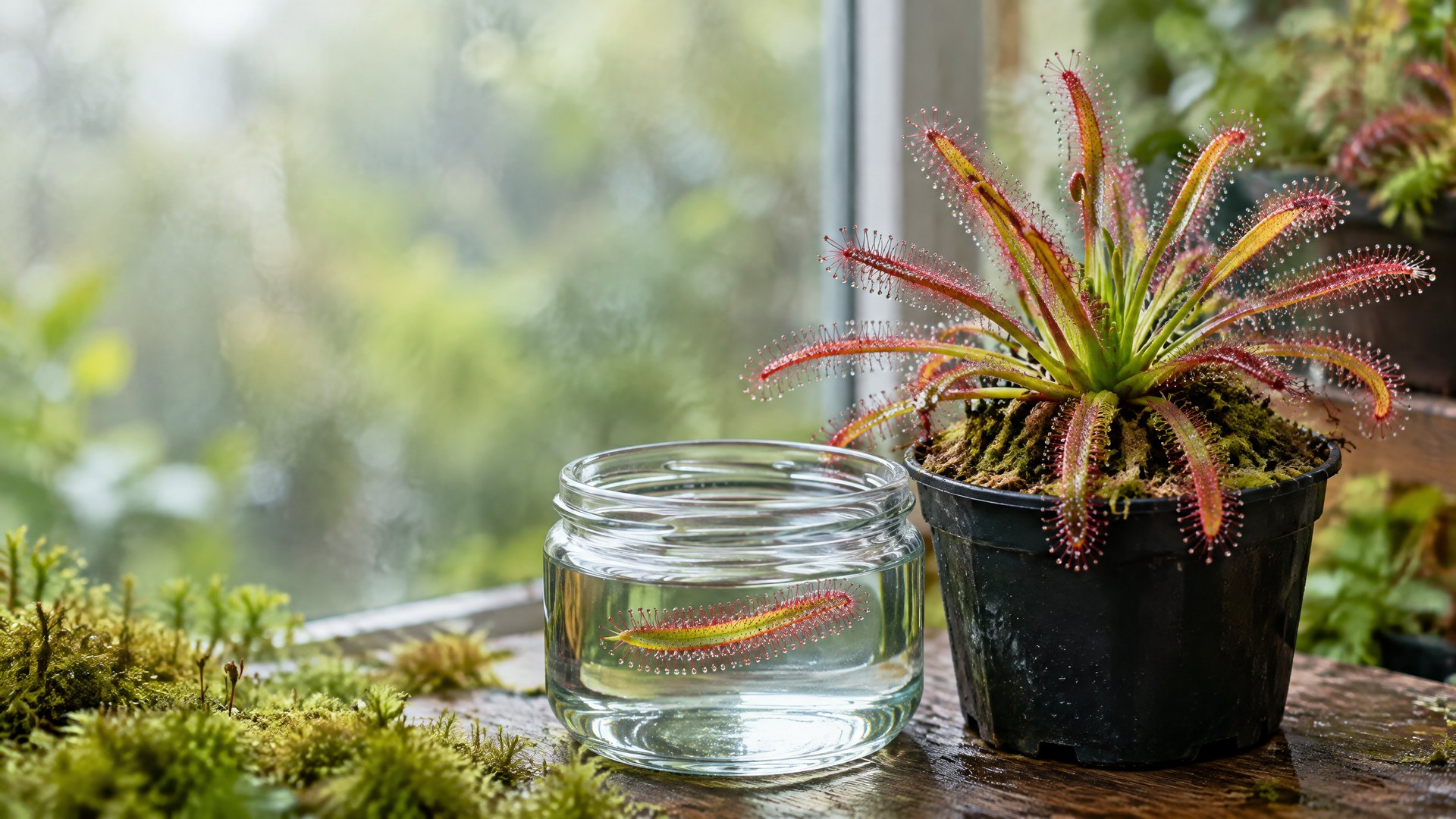
A Cape sundew, Drosera capensis, is one of the more approachable sundews for a careful vegetative propagation experiment. A leaf cutting can produce a clone of the parent plant, which is useful when a particular plant is healthy and growing well in your collection. It is not a shortcut that works for every sundew, every leaf or every growing setup.
The best first step is to identify the plant. This guide is about Drosera capensis and other similar larger-leaved sundews, not a universal method for all Drosera. Pygmy sundews, tuberous sundews and species with specialised growth habits can need different propagation methods. Begin with Sundews in Ireland if you are unsure which group you have.
For an Irish indoor collection, the aim is not to create a sealed miniature rainforest or chase a fixed countdown. It is to take one or two good leaves from an actively growing plant, use suitable water or medium, and make conditions stable enough for you to observe what happens.
Why use a leaf cutting instead of seed?
A successful leaf cutting is genetically the same as the parent plant. The International Carnivorous Plant Society (ICPS) describes this as one of the main reasons to use leaf cuttings: it lets a grower keep an exact copy of a plant that is already performing well, rather than starting a variable group of seedlings. ICPS leaf-cutting guide
That does not make leaf cuttings automatically easier than seed. They can fail through poor leaf condition, unsuitable water, overheating under a cover or frequent handling. Take them when the parent is in vigorous growth, not when it is recovering from a move, drying out or changing its seasonal habit.
Choose a healthy, active Cape sundew
The ICPS recommends fully open leaves with plenty of dew for leaf propagation. Choose a leaf that is clean, undamaged and still contributing to the parent plant’s growth. Avoid taking every good leaf from a small specimen; leave the parent with enough healthy foliage to continue growing normally.
Use a clean sharp blade or fine scissors. Cut the leaf along the petiole, the less-dewy stalk section, rather than tearing the crown. That gives you a cutting with the tentacle-bearing part intact while reducing disturbance to the centre of the parent plant.
If the plant has recently lost dew, changed colour sharply or stopped making new leaves, solve that care issue first. Review water for carnivorous plants in Ireland, rainwater collection and use and your light level before removing material for propagation.
Method one: float the leaf in clean water
The clean-water method is a simple way to watch the cutting without burying it in a medium. The ICPS suggests placing the leaf tentacle-side up in a shallow amount of pure water in a small jar, tube or other clean container. Distilled or reverse-osmosis water is the specialist recommendation for this method. A clear cover can reduce evaporation and keep the humidity around the leaf high.
- Rinse a small container so there is no detergent residue.
- Add a shallow amount of distilled or reverse-osmosis water.
- Float the leaf with the tentacle side facing upward.
- Label the container with the plant name and cutting date.
- Cover it loosely enough to keep the environment humid while still letting you inspect the water and leaf.
If the water becomes cloudy, the ICPS advises changing it. Do not keep lifting the leaf for a closer look. A dated label and occasional gentle observation are more useful than repeatedly resetting the cutting.
Method two: place the leaf on suitable wet medium
A second approach is to lay the leaf on the surface of a medium suitable for the adult plant, such as sphagnum, peat, peat-and-sand or a prepared carnivorous-plant medium. The key is close contact between the leaf and a very moist medium, while the leaf remains visible enough for you to monitor it.
Carnivorous Plant Nursery describes using a fresh mature leaf on moist finely chopped sphagnum in a high-humidity, shaded, warm-but-not-hot setting. Specialist propagation guide The exact container is less important than the conditions: no ordinary enriched compost, no sudden drying and no sun-driven heat build-up under a clear cover.
The Royal Horticultural Society also advises using specialist low-nutrient compost for carnivorous plants rather than ordinary potting compost, and lists leaf cuttings as a propagation method for sundews. RHS growing guide
Water or medium: choose one simple setup
Both methods can be reasonable. Water is easy to observe and starts the leaf in a comparatively clean environment. A moist propagation pot means that a successful plantlet is already sitting in the type of medium it will need later. There is no need to run both systems at once on your first attempt.
Choose the method you can monitor without overhandling. In a cool, low-light part of an Irish home, a covered container can stay wet for much longer than you expect. In a warm bright spot, a small jar can warm quickly. Keep the setup bright but protected from harsh direct sun, and move it only when there is a clear reason.
Grow Sundews, a specialist Drosera resource, lists D. capensis among larger-leaved sundews that can be propagated from whole leaves or leaf sections. It describes both water striking and a moist medium under a cover, while making clear that the best practical method is the one that remains stable in the grower’s conditions. Grow Sundews propagation guide
Light, humidity and patient observation
A cutting needs light, but a transparent cover can trap heat. The ICPS recommends plenty of light without roasting the leaf. A bright indoor position or managed grow light can work if the container remains cool enough and the medium or water does not dry unexpectedly. If you are revising indoor lighting, see best grow lights for carnivorous plants in Ireland before changing several variables at once.
High humidity is useful for a detached leaf, but an untouched sealed container is not automatically safe. Inspect it regularly for stagnant water, obvious fungus or a leaf that has fully collapsed. Remove a fully brown or clearly decaying leaf rather than leaving it to foul the entire setup. If part of the leaf remains green or red, do not assume it has failed merely because plantlets are not visible yet.
Avoid fertiliser in the cutting water or medium. This is a propagation stage, not an opportunity to push rapid growth. The value of a simple setup is that it gives you a chance to notice what the leaf and the water or medium are actually doing.
When you see tiny plantlets
New plantlets can be easy to damage. The ICPS recommends allowing them to develop a few leaves before moving them into their preferred growing medium. When they are ready, prepare a small pot of unfertilised carnivorous-plant medium first, then lift the plantlet gently with a clean tool rather than pulling on its tiny leaves.
Keep the small pot evenly moist with suitable water and avoid abrupt changes in light or humidity. Gradual acclimation is more useful than moving a young plantlet from a covered container straight into a dry room or very intense light. Carnivorous Plant Nursery similarly recommends allowing new plantlets to develop their own root systems before separating and slowly acclimating them to normal growing conditions.
A new plantlet is not yet a mature display plant. Give it time to establish before repotting, feeding or making several care changes. For the longer-term care picture, return to the sundew plant hub and Sundews in Ireland.
Mistakes that make leaf cuttings harder
- Taking leaves from a stressed parent: a cutting cannot compensate for a plant that is already struggling.
- Treating all sundews as interchangeable: identify the group before choosing a propagation method.
- Using mineral-rich or dirty water: clean distilled or reverse-osmosis water keeps the water method straightforward.
- Using ordinary enriched compost: choose unfertilised carnivorous-plant medium instead.
- Cooking a cutting under a cover: bright light is useful, but trapped heat is not.
- Moving tiny plantlets too early: let them make several leaves before a careful transfer.
- Changing water, light, humidity and medium all at once: one stable method teaches you more than a series of reactions.
A calm leaf-cutting checklist
- Confirm that the parent is a Cape sundew or another suitable larger-leaved Drosera.
- Take only one or two fully open healthy leaves from an actively growing parent.
- Use either clean distilled or reverse-osmosis water, or a very moist unfertilised carnivorous-plant medium.
- Label the method and date so you can compare future attempts.
- Keep the cutting bright, humid and protected from heat build-up.
- Inspect without excessive handling and change cloudy water if using the water method.
- Wait for several leaves on a plantlet before transferring it carefully.
Continue learning
- Sundews in Ireland — Match propagation to the broader care needs of your plant.
- The complete guide to water — Choose appropriate water before making any cutting setup.
- Rainwater for carnivorous plants — Consider collection and storage as part of a low-mineral water routine.
- Best grow lights for carnivorous plants in Ireland — Review indoor lighting without creating excessive heat.
Research & sources
These references support the practical and conservation notes on this page.
- International Carnivorous Plant Society — Drosera Leaf Cuttings: Specialist guidance on healthy leaves, clean-water and medium methods, environmental conditions and transfer after plantlets make several leaves.
- Royal Horticultural Society — How to Grow Carnivorous Plants: Specialist low-nutrient compost and rainwater context; lists leaf cuttings as a sundew propagation option.
- Carnivorous Plant Nursery — Propagation: Specialist grower guidance on fresh mature leaves, moist sphagnum, humidity, non-overheating conditions and gradual acclimation.
- Grow Sundews — Propagating Sundews: Species-specific specialist context for using whole leaves or leaf sections from larger-leaved sundews including Drosera capensis.
Frequently Asked Questions
Can every sundew be propagated from leaf cuttings?
No. The International Carnivorous Plant Society notes that leaf-cutting response varies widely across Drosera. Cape sundews are a useful candidate, but pygmy, tuberous and some other groups need different methods.
Should I strike Cape sundew leaf cuttings in water or in a pot?
Both approaches are used by specialist growers. Clean distilled or reverse-osmosis water makes the cutting easy to observe, while a suitable moist carnivorous-plant medium lets a plantlet begin in the medium it will later grow in. Choose one method and keep the conditions stable.
When should I move a tiny sundew plantlet into a pot?
The International Carnivorous Plant Society recommends waiting until plantlets have developed a few leaves before transferring them into their preferred medium. Transfer gently and avoid trying to force rapid growth with fertiliser.
Do leaf cuttings make the same plant as the parent?
Leaf cuttings are a vegetative method, so successful plantlets are clones of the parent plant. That is different from growing seedlings, where genetic variation can appear.