Should You Feed a Venus Flytrap? The Science of Feeding
Feeding raw steak, hamburger meat, or dead flies into a Venus flytrap is the fastest way to cause rotten traps. Here is the physiological truth about carnivorous plant nutrition.
By Bog & Bite · Published 25 September 2026
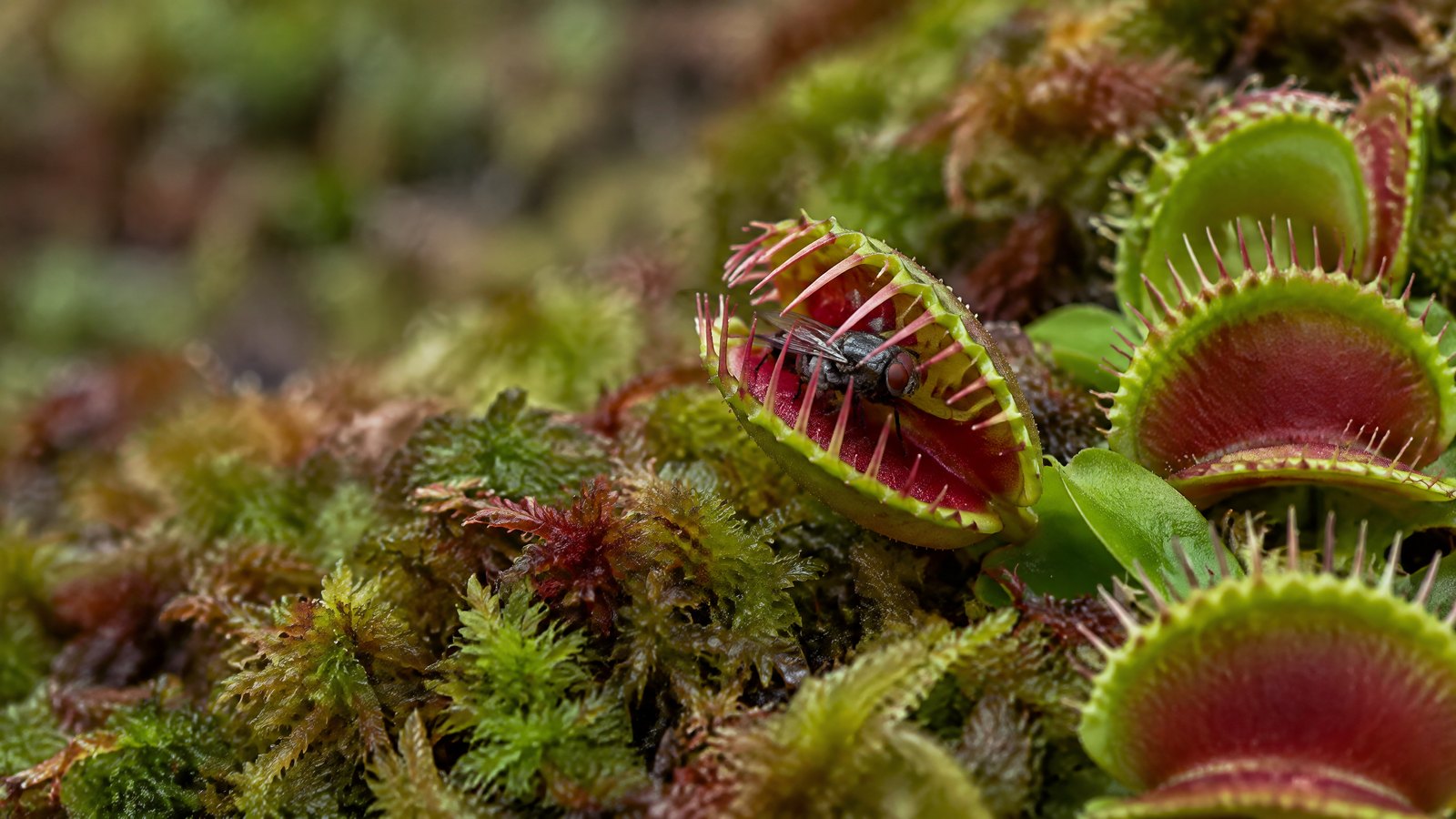
The irresistible spectacle of a Venus flytrap snapping shut in a fraction of a second is what captures the imagination of children and adult botanists alike. It is completely natural that new owners want to participate in the drama by feeding their plant.
However, human food, dead bugs dropped into motionless traps, and chronic manual triggering are among the leading causes of plant decline.
To feed a carnivorous plant correctly, one must first dismantle a fundamental linguistic error: carnivorous plants do not "eat" in the animal sense. They are autotrophic green plants that generate their primary energy and carbohydrates via solar photosynthesis. The insects they catch are not food for calories; they are natural foliar fertiliser—a vital source of nitrogen, phosphorus, potassium, and trace minerals absent from bog soils.
The Mechanical Trap: Why Dead Insects Fail
A Venus flytrap leaf lobe features three microscopic, sensitive trigger hairs (trichomes) arranged in a triangle on the internal surface of each lobe.
The trapping sequence occurs in two distinct physiological phases:
- The Fast Snap (Action Potential): When an insect bends a trigger hair once, a minute electrical charge ripples across the leaf cells. If a second hair (or the same hair) is touched within 20 to 30 seconds, a sudden rush of water across motor cells alters cellular turgor pressure, snapping the trap shut in approximately 100 milliseconds.
- The Sealing & Digestion Phase (The Struggle Test): At this stage, the marginal spines lace together like prison bars, but the trap is not sealed. If the caught object was a falling twig, raindrop, or human pencil tip, there is no movement. Sparing its metabolic resources, the trap reopens 24 to 48 hours later.
- However, if a live insect is trapped inside, its frantic struggles bend the trigger hairs repeatedly. This sends continuous electrical pulses that signal the plant: "Valid prey confirmed!" The lobes press tightly together, forming a hermetic, watertight seal, and glandular cells flood the interior with digestive proteases and hydrochloric acid.
The Golden Takeaway: If you drop a dead insect into a trap, the trap will snap shut—and then do nothing. It will fail to seal and reopen two days later without digesting the meal.
If You Must Hand-Feed an Indoor Plant: The Proper Method
If your plant is kept on an indoor windowsill behind double glazing where insects rarely venture, giving it a supplemental meal once a month during the active growing season (May to August) will stimulate robust growth.
1. What to Feed:
- The Best Prey: Live or freshly rehydrated freeze-dried bloodworms (sold in blister packs at Irish aquatic pet shops for aquarium fish). Bloodworms are pure, clean insect larvae rich in chitin and protein.
- Acceptable Prey: Live houseflies, small spiders, or bluebottle maggots.
- The Size Rule: The prey item must never exceed one-third the length of the trap. If the insect’s wings or legs poke out through the marginal spines, air enters, bacteria multiply, and the trap turns black and rots.
2. How to Trigger Digestion with Dead Prey:
- Moisten a tiny pinch of freeze-dried bloodworm with a drop of pure rainwater to form a small pellet.
- Using fine tweezers, place the pellet into the centre of a fully open trap.
- Gently touch the trigger hairs with a toothpick until the trap snaps shut.
- Now, the crucial step: simulate life. Using your thumb and forefinger, gently massage the outside of the closed trap lobes two or three times over the next 10 minutes. This stimulation triggers the mechanical hairs inside, convincing the plant that live prey is struggling, initiating the tight hermetic seal and digestive enzyme secretion.
What NEVER to Feed a Flytrap
- Raw Meat, Bacon, or Sausage: High animal fats cause rapid putrefaction and rot the entire leaf.
- Dead Spiders Found in Dust Bins: Often contaminated with chemical household bug sprays.
- Fertiliser Pellets / Miracle-Gro: Concentrated mineral fertilisers dropped into traps will induce toxic chemical burns.
- Cheese, Bread, or Milk: Decays into rancid bacterial curd that destroys the leaf.
Feed only when it serves a clear purpose
A flytrap makes most of its energy through photosynthesis. Insects supply nutrients that are scarce in its natural low-nutrient habitat, so feeding is not a substitute for sufficient light, appropriate water or healthy roots. An outdoor plant may catch enough prey without intervention. A struggling plant is usually better helped by correcting its growing conditions than by adding more food.
If you choose to feed an indoor plant, use a suitably small, appropriate item in one or two healthy traps. Avoid fertiliser in the growing medium, human food and repeated empty closures. After a trap closes, leave it alone. A trap can blacken as part of its normal lifespan, particularly after closing and digesting, so judge the plant by ongoing new growth rather than one spent leaf. NYBG recommends feeding only one or two traps rather than every trap and avoiding food larger than roughly a third of the trap. NYBG flytrap care
Continue learning
- Why Is My Venus Flytrap Dying? — Learn why a spent or blackened trap does not necessarily mean the whole plant is failing.
- Venus Flytrap Dormancy — Avoid treating a slowing plant as if it needs more feeding.
- Can Venus Flytraps Live Outside? — Outdoor plants often catch suitable prey without manual feeding.
Research & sources
These references support the practical and conservation notes on this page.
- U.S. Fish & Wildlife Service — Venus Fly Trap (Dionaea muscipula): Native habitat and the role of insects as a nutrient source.
- International Carnivorous Plant Society — Growing Dionaea muscipula: Light, water, feeding, outdoor culture and condition-led repotting.
- New York Botanical Garden — Venus Flytrap Houseplants: Black traps, safe manual feeding, water and repotting.
- Royal Horticultural Society — How to care for your Venus fly trap: Spring repotting, winter rest and why repeated empty closures are unhelpful.
Frequently Asked Questions
Do outdoor Venus flytraps in Ireland need to be fed by hand?
NO! Outdoor plants in an Irish garden or patio catch far more insects than they can digest. Between May and September, they capture abundant spiders, wasps, flies, and crane flies without human help.
Can I feed a flytrap a tiny piece of raw beef or chicken?
ABSOLUTELY NEVER. Mammalian meat contains complex animal fats and high protein densities that carnivorous plant enzymes cannot process. The meat will quickly rot, coating the trap in bacterial slime and killing the leaf within days.
How does a trap know whether it has caught real prey?
A Venus flytrap uses a dual-trigger mechanism. The trap first snaps shut when trigger hairs are touched twice within 20 seconds. However, the plant only produces digestive enzymes if the struggling prey continues to stimulate the hairs repeatedly over the following 30 minutes, creating a watertight hermetic seal.